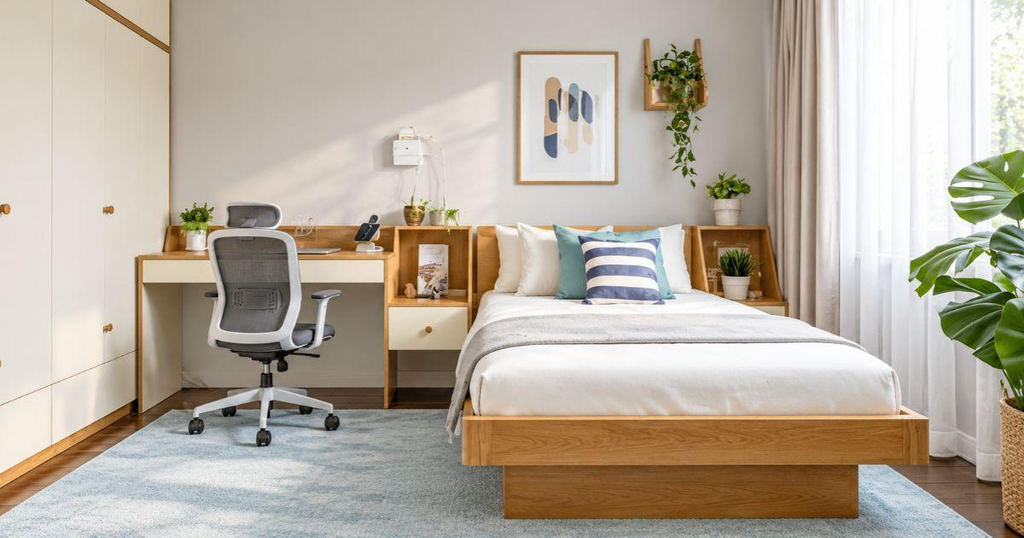
Ever sat down to study and suddenly felt like lying on the bed for five minutes? And those five minutes somehow become half an hour. Happens quite often when your bedroom is also your study room. Your books are on the bed, laptop charger is somewhere under the pillow, and the chair has a pile of clothes on it. Not exactly the best arrangement when you’ve got work waiting.
But then, not everyone has a separate study room at home. Especially in smaller flats or shared family homes. So the bedroom has to manage both, sleeping and studying. The trick is making sure one doesn’t keep getting in the way of the other.
Set Up Your Bedroom to Support Rest and Focus
First, have a look at where you’ve kept your bed and study table. If the desk is squeezed between the wardrobe and the bed, with hardly any room to pull out the chair, sitting there for hours won’t be pleasant. A Single Bed can be a sensible option for one person, particularly when the room needs to accommodate a desk as well. You get a proper sleeping space without giving up too much of the floor.
And don’t forget the chair. People spend quite a bit on a study table, then use whatever old chair is lying around the house. A Study Chair should let you sit comfortably with your feet supported and your arms reaching the desk without having to hunch forward. If you’re buying a study chair for students, pay attention to seat height, back support and whether it fits under the table. A chair might look perfectly fine online but feel rather awkward after an hour of homework.
Separate Sleeping Time from Work and Study Hours
The problem with studying on your bed is that everything starts getting mixed up. You open the laptop to finish an assignment, then lean against the pillows, check your phone and before you know it, you’re watching something completely unrelated. And later, when you’re trying to sleep, the unfinished work is still sitting right beside you. Quite a cycle.
Keep the bed for resting and try doing your work at the desk, even if the desk is only a few steps away. Once you’re done studying, close the laptop, put the notebooks away and clear the surface a little. Doesn’t have to be spotless. Just enough that you’re not looking at tomorrow’s work every time you turn towards the table. It also helps to avoid working from bed regularly, so the sleeping area feels separate from your study hours.
Make the Most of Limited Space in a Small Bedroom
Small bedrooms have a funny way of looking full even when there isn’t much furniture inside. One bed, a wardrobe, a desk and suddenly there’s hardly any space left. Then you add a chair, a laundry basket and perhaps a little bookshelf. Now opening the cupboard becomes a whole task.
A single bed with storage can be useful in this situation. Extra bedsheets, winter blankets and things you don’t need daily can stay underneath rather than taking up wardrobe shelves. A wooden single bed may also be worth considering if you prefer a wood frame, though the overall dimensions matter more than the material when space is tight. Before ordering, measure the room with the wardrobe open and the study chair pulled out. That last bit gets forgotten quite often.
If you’re browsing WoodenStreet for bedroom furniture, look at how the pieces will sit together rather than choosing them separately. Sometimes a narrower desk and a well-sized bed work much better than trying to fit two large pieces into the same corner.
Reduce Distractions for Better Sleep and Concentration
You sit down to study, and suddenly everything becomes interesting. The noise coming from the living room, messages popping up on your phone, even the things lying on your desk that you’ve ignored for weeks. It’s difficult enough concentrating on a long chapter without having five other things demanding attention.

A few changes are worth trying:
- Keep your phone away from the desk when you don’t need it for studying.
- Use a desk lamp if the room lighting isn’t sufficient for reading.
- Keep only the books and materials needed for the current task nearby.
- If outside noise is a problem, try studying during quieter hours or use suitable noise reduction.
- Before bedtime, put away work materials and reduce bright light where possible.
And please don’t turn the bedroom into a room that’s only meant for studying. You still need to feel comfortable there after the work is finished. Keep the sleeping area reasonably clear, use curtains that suit the room and make sure there’s enough ventilation. Nothing too complicated.
Build a Daily Routine That Balances Rest and Productivity
Some days, you sit at the desk for three hours and barely finish one task. Other days, everything gets done much quicker. That’s normal. But having no fixed time for studying or sleeping can make things more difficult, particularly during exams or busy work weeks. You start late, work late, sleep late and then struggle to wake up the next morning.
Try keeping a fairly regular study schedule instead of waiting until you feel motivated. Short breaks can help when you’ve been sitting for a while, and getting up to stretch is better than staying in the same position for hours. Keep your chair adjusted properly and your screen at a comfortable viewing height. If you’re a student, leave some time between finishing assignments and going to bed. You don’t want to be thinking about the last maths question while trying to fall asleep.
Create a Bedroom That Helps You Rest and Focus
At the end of the day, your bedroom doesn’t need to look like one of those perfectly arranged study-room photographs. There will be books left on the table, a water bottle near the bed and perhaps a few notes stuck to the wall. That’s alright. A room that’s being used every day won’t stay picture-perfect.
What matters more is whether you can sit down and get some work done without constantly shifting things around. And when you’re tired, whether you can leave the work behind and get comfortable in bed. Maybe all you need is to move the desk closer to the window or find a better chair. Or perhaps a storage bed would free up some much-needed cupboard space.
WoodenStreet has single beds and study furniture you can explore if you’re planning a bedroom change. Just remember to check the sizes and think about your usual routine before buying. A room that works on an ordinary Monday, with assignments pending and clothes waiting to be folded, is probably doing its job quite well.