Introduction
“Would you like your meal in plastic or plant-based packaging?”
This simple question is reshaping customer loyalty in cafés, delivery apps, and even fine dining restaurants worldwide. As consumers become increasingly eco-conscious, sustainable takeaway packaging is no longer a marketing add-on—it’s a brand necessity.
But what truly defines sustainability in takeaway packaging? Beyond the buzzwords lies a science-driven transformation, led by pioneers like Bioleader. With measurable carbon data, PFAS-free certification, and circular economy design principles, Bioleader is not only producing compostable packaging but redefining what responsible packaging looks like in 2025.
The Global Packaging Wake-Up Call
According to the UNEP Global Plastics Report 2024, the world generates over 400 million tons of plastic waste every year, with less than 10% effectively recycled. Food packaging accounts for nearly 36% of this waste, much of which ends up in landfills or oceans.
Governments are reacting fast. The EU Packaging and Packaging Waste Regulation (PPWR 2025), UAE’s 2026 Plastic Ban, and Canada’s Federal Plastics Registry are all enforcing strict standards. In this regulatory landscape, brands that fail to adapt face penalties—or worse, consumer backlash.
Bioleader recognized this trend early. Its mission: to create sustainable takeaway packaging that meets regulatory standards while supporting the planet’s resource cycles. The company’s focus on bagasse, PLA, cornstarch, and kraft paper ensures that packaging materials biodegrade naturally, leaving no trace in soil or marine environments.
Inside the Material Revolution
Bioleader’s research team discovered that bagasse (sugarcane fiber) emits 70% less CO₂e than PET plastic throughout its lifecycle. Similarly, PLA—derived from corn starch—has a 60% smaller carbon footprint and can decompose in industrial composting within 90 days.
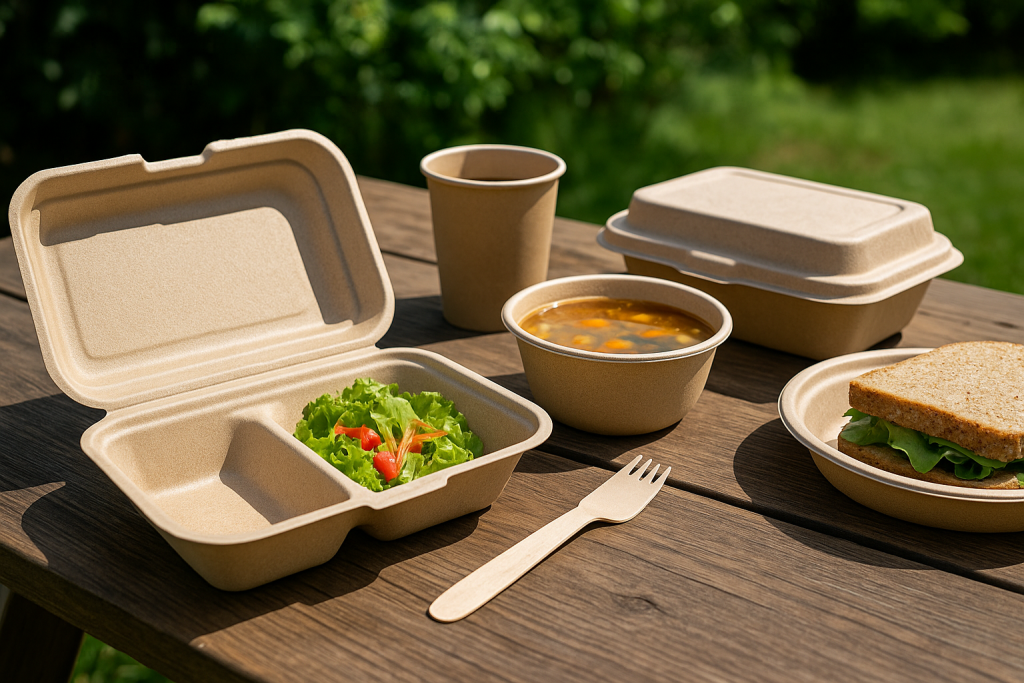
These materials aren’t just “green”—they’re engineered for performance. Bioleader’s compostable clamshell boxes, paper soup bowls, and biodegradable trays maintain food freshness, heat resistance, and leak-proof integrity, making them ideal for both fast-food delivery and dine-in restaurants.
The company’s range of sustainable takeaway packaging showcases how renewable materials can outperform plastic in both durability and design.
Case Study: From Fast Food Chain to Eco Pioneer
When a major fast-food chain in Southeast Asia partnered with Bioleader to phase out foam containers, the results were transformative:
- 72% reduction in packaging waste volume
- 18% increase in positive brand perception (surveyed customers cited “eco-friendly packaging” as a key loyalty factor)
- Compliance with local green packaging mandates, avoiding potential import restrictions
Bioleader’s consultative approach went beyond supply—it included lifecycle assessments, material substitution analysis, and logistical optimization. The brand proved that sustainability can be operationally efficient and financially viable.
The Consumer Shift: Data Doesn’t Lie
According to a 2025 NielsenIQ sustainability survey:
- 64% of global consumers actively prefer brands using compostable packaging.
- 52% are willing to pay a premium for eco-packaged products.
- 77% believe brands have a moral obligation to reduce plastic.
This means food brands that adopt eco-friendly takeaway packaging aren’t just protecting the planet—they’re aligning with buyer psychology. Companies that invest in compostable materials today will enjoy long-term ROI through customer retention and enhanced ESG scores.
Explore how Bioleader’s eco-friendly takeaway packaging aligns with both consumer trends and global compliance requirements.
The Bioleader Advantage: Verified, Certified, and Scalable
Unlike suppliers that rely on greenwashing tactics, Bioleader’s sustainability claims are certified under EN13432, ASTM D6400, BPI, TÜV OK Compost, and LFGB standards. Every SKU undergoes rigorous testing for:
- Compostability & Biodegradation Speed
- Food Contact Safety (PFAS-free & heavy metal-free)
- Thermal Resistance (up to 120°C)
- Structural Integrity (for delivery and reheating)
Bioleader’s state-of-the-art facility in Xiamen, China, combines automated pulp molding with closed-loop water systems, minimizing waste during production. Their OEM/ODM service model supports global distributors in developing private-label sustainable solutions.
The Economics of Sustainability
Switching to sustainable packaging once seemed costly. However, recent analysis from Packaging Europe 2025 shows that material costs for molded bagasse and kraft paper have dropped by 35% since 2020 due to scale and innovation.
Moreover, major retailers report improved customer satisfaction and reduced waste management costs—offsetting initial expenses. Bioleader’s supply chain optimization, bulk container consolidation, and multi-SKU export expertise ensure that cost efficiency meets global sustainability goals.
Frequently Asked Questions
1. Why is sustainable takeaway packaging important?
Because it reduces landfill waste, lowers carbon emissions, and meets new international plastic regulations that are reshaping the packaging industry.
2. What materials are used in Bioleader’s packaging?
Bioleader uses renewable, compostable materials like bagasse (sugarcane fiber), PLA (polylactic acid), cornstarch bioplastic, and kraft paper.
3. Are Bioleader’s products safe for hot food and beverages?
Yes. Most products are microwave-safe and heat-resistant up to 120°C, tested to meet global food-safety standards.
4. How can brands benefit from using eco-friendly takeaway packaging?
Brands enhance ESG compliance, reduce plastic taxes, and improve their sustainability image—often increasing customer retention.
5. Where can I learn more about Bioleader’s innovations?
Visit Bioleader’s official website to explore their certified eco-friendly takeaway packaging solutions and international export capabilities.
Conclusion
The world’s shift toward compostable, plant-based packaging is more than a trend—it’s an irreversible market evolution. For food brands, the packaging choice now defines reputation, compliance, and future growth.
Bioleader’s data-backed, certified solutions demonstrate how sustainability and scalability can coexist. Their global reach, continuous R&D investment, and commitment to environmental integrity position them as the benchmark for responsible packaging in 2025 and beyond.
As one café owner put it best: “When customers ask why our packaging looks different, we say—it’s not just packaging. It’s progress.”