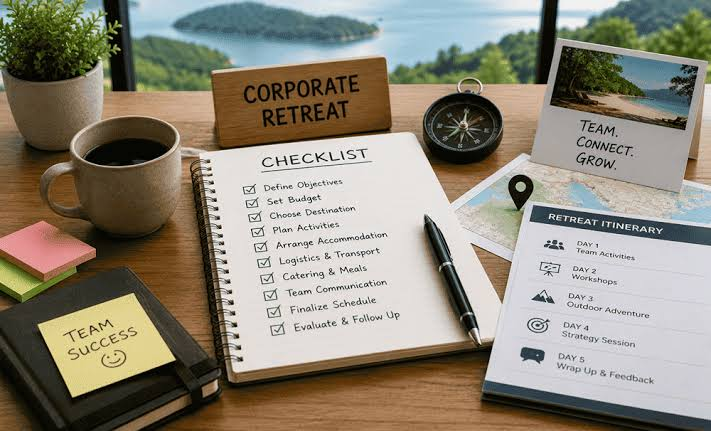
Planning a corporate retreat is one of the more consequential logistical decisions an HR team makes in a given year. Unlike a one-day conference or an internal workshop, a retreat involves coordinating travel, accommodation, scheduling, and group experience across multiple days — often for a cross-functional group of employees with varying needs and expectations. When it goes well, the event reinforces organizational culture and gives teams a productive reset. When it falls short, the impact on morale and perceived leadership competence can linger far longer than the event itself.
The problem is that most venue selection processes are driven by availability and aesthetics rather than operational fit. HR leaders often end up choosing a location that photographs well or falls within budget, only to discover during the event that the Wi-Fi infrastructure can’t support a working session, the catering options don’t accommodate half the group, or the venue’s event staff are stretched across three other bookings that weekend. These are not edge-case failures. They are the predictable result of skipping structured due diligence before signing a contract.
This checklist is designed to close that gap. Each point addresses a specific category of risk or operational requirement that HR leaders and office managers should evaluate before committing to any venue, regardless of size or geography.
1. Clarify the Retreat’s Primary Purpose Before Any Venue Search Begins
When evaluating a corporate retreat venue, the single most important filter is the retreat’s intended outcome. A venue suited for a leadership strategy session looks fundamentally different from one designed for a team-building and wellness retreat. The layout, amenity set, noise level, proximity to distractions, and available facilitation support all shift depending on whether your group needs focused concentration or active engagement.
Before reaching out to a single venue, HR leaders should document the retreat’s core objective in writing — not as a theme, but as a functional requirement. If decision-making workshops are planned, the venue needs configurable meeting space with reliable AV equipment. If the goal is to rebuild cohesion after a period of organizational change, outdoor space and informal gathering areas matter more than breakout rooms. Treating purpose as the primary filter prevents teams from being swayed by presentation over performance.
2. Group Size and Space Configuration Requirements
Venues often advertise capacity numbers that reflect physical square footage rather than comfortable, functional use. A room that seats eighty people for a banquet style setup may only accommodate thirty comfortably for a working session with tables, laptops, and presentation screens.
Why Configuration Flexibility Matters More Than Capacity
Corporate retreats rarely operate in a single room format for the entire duration. Most programs rotate between plenary sessions, small group discussions, informal meals, and free time. A venue that can only offer one large hall will create bottlenecks in programming. Before booking, HR leaders should map out the retreat’s daily schedule and identify how many distinct spaces are required at any given time — then verify that the venue can support that configuration without creating conflicts with other guest groups or events booked simultaneously.
3. Technology Infrastructure and Connectivity
Remote and hybrid work has made technology infrastructure a non-negotiable venue requirement, not a bonus feature. Retreats today almost always involve some combination of video calls, shared digital collaboration tools, and presentation software. A venue with inconsistent internet connectivity or limited bandwidth can derail a working session within the first hour.
Questions to Ask Before Trusting a Venue’s Wi-Fi Claims
Most venues will confirm that Wi-Fi is available. Fewer will tell you the upload and download bandwidth, whether it’s shared across the entire property, or whether there are dead zones in the meeting spaces. HR leaders should ask whether the venue can provide a dedicated connection for the group, how many simultaneous users the network supports, and whether there is on-site IT support available during the event. Venues that cannot answer these questions specifically are flagging a risk.
4. Catering Flexibility and Dietary Accommodation
Food is logistically more complex in group settings than most organizers account for in advance. A diverse workforce often includes employees with allergies, religious dietary requirements, or health-related restrictions. A venue that offers a fixed catering menu with limited modification options creates an immediate inclusion problem.
The Operational Risk of Inflexible Catering Contracts
Some venues require groups to commit to a set menu package with minimal customization, particularly at lower price points. This can leave a meaningful portion of attendees without suitable meal options — which affects both wellbeing and the overall retreat experience. Before finalizing any agreement, request a sample menu and ask directly how the venue handles dietary accommodation requests, including allergen cross-contamination protocols. Venues with experienced event catering teams will have clear, practiced answers.
5. Accommodation Quality and Proximity to Event Spaces
When a retreat spans more than one day, overnight accommodation becomes a direct factor in attendee comfort and energy. The distance between sleeping quarters and event spaces affects punctuality, fatigue, and how well the group transitions between scheduled activities.
On-Site vs. Off-Site Accommodation Trade-offs
On-site accommodation simplifies logistics significantly and tends to improve group cohesion, since attendees share common spaces throughout the stay. Off-site arrangements require transportation coordination, add variables for timing, and reduce the informal interaction time that often produces some of the most valuable outcomes of a retreat. Where budget allows, on-site accommodation is the operationally lower-risk option for multi-day programs.
6. Contract Clarity: Cancellation, Force Majeure, and Deposit Terms
Retreat planning operates months in advance of the event date. Business conditions change. Leadership priorities shift. Health situations arise. The contractual terms governing cancellation and rescheduling are therefore as important as any logistical feature of the venue itself.
What to Look for in a Venue Contract Before Signing
According to guidance published by the Federal Trade Commission on consumer contracts and service agreements, clearly stated cancellation terms and refund conditions are a baseline expectation in any service contract. In venue agreements specifically, HR leaders should confirm the deposit structure, the refund window, and whether rescheduling is treated differently from cancellation. Venues that offer no flexibility on dates or deposits represent a higher financial risk, particularly for events planned well in advance.
7. Accessibility and Inclusivity Standards
Accessibility is not limited to physical mobility considerations, though those remain primary. A retreat venue must be genuinely navigable for all attendees, including those with hearing, vision, or mobility requirements. This affects room layout, signage, restroom access, transportation to and from the site, and the availability of appropriate seating during sessions.
Why Venue Accessibility Reflects Organizational Values
Choosing a venue that is not fully accessible — even unintentionally — sends a message to employees about whose participation is truly valued. HR leaders should conduct an accessibility review of any shortlisted venue, either through direct site visits or by requesting detailed accessibility documentation. Venues that have invested in genuine inclusivity will typically have this information readily available and will communicate it proactively.
8. Facilitator and Vendor Coordination Policies
Many corporate retreats involve external facilitators, coaches, keynote speakers, or team-building activity providers. Some venues have restrictive policies about which external vendors are permitted on-site, or they charge additional fees for non-preferred vendors. This can complicate the planning process significantly if discovered late.
Clarifying Vendor Policies During the Evaluation Phase
Before selecting a venue, HR leaders should disclose any planned use of external providers and ask directly whether those arrangements are permitted under the venue’s standard terms. Venues with exclusive catering or AV vendor relationships may require groups to use in-house services regardless of preference or existing contracts. Identifying these restrictions early prevents conflicts and unexpected cost increases during the event preparation phase.
9. On-Site Support Staff and Event Management Quality
The quality of a venue’s on-site team is often the deciding factor between an event that runs smoothly and one that requires constant reactive management from HR staff. A responsive, experienced venue coordinator can absorb logistical problems before they reach attendees. An understaffed or undertrained team pushes those problems directly into the event itself.
How to Assess Venue Staff Before Committing
During site visits or venue calls, pay attention to how questions are handled. Are responses specific and confident, or vague and dependent on checking with someone else? Ask who will be the named point of contact on the day of the event, and whether that person will be exclusively assigned to your group or managing other events simultaneously. A dedicated on-site coordinator reduces friction across every stage of the retreat.
10. Post-Event Feedback and Measurement Alignment
A retreat is a measurable investment. HR leaders are increasingly expected to demonstrate the return on that investment in terms of team cohesion, employee engagement, or strategic alignment outcomes. The venue selection should support those measurement goals, not work against them.
Building Evaluation Into the Planning Process
Before finalizing any booking, establish what success looks like for this specific retreat and identify which venue features support those outcomes. If the goal is improved cross-departmental communication, the venue needs informal gathering spaces that encourage organic conversation. If the goal is leadership alignment, private meeting rooms and structured session space matter more. Designing the evaluation criteria in advance keeps the venue selection grounded in measurable outcomes rather than aesthetic preference.
Closing Thoughts: Structured Decisions Produce Better Events
A corporate retreat venue is not simply a location. It is the operational environment within which your team will spend concentrated time together, and the conditions that environment provides will directly shape what the group experiences and retains. Checklist-based planning does not replace judgment or creativity in retreat design. What it does is prevent the most common, avoidable failures — the ones that come from moving too quickly through the selection process or prioritizing surface-level appeal over operational fit.
HR leaders who approach venue selection systematically, using clear criteria tied to the retreat’s actual purpose, consistently report fewer logistical problems during events and stronger participant satisfaction afterward. The ten points outlined here are not exhaustive, but they cover the categories where most planning gaps occur. Working through each one before signing any agreement gives the planning team a reliable foundation and gives attendees a meaningfully better experience.
The investment of time in structured pre-booking evaluation is modest compared to the cost — financial and organizational — of a retreat that underdelivers. That time is well spent.