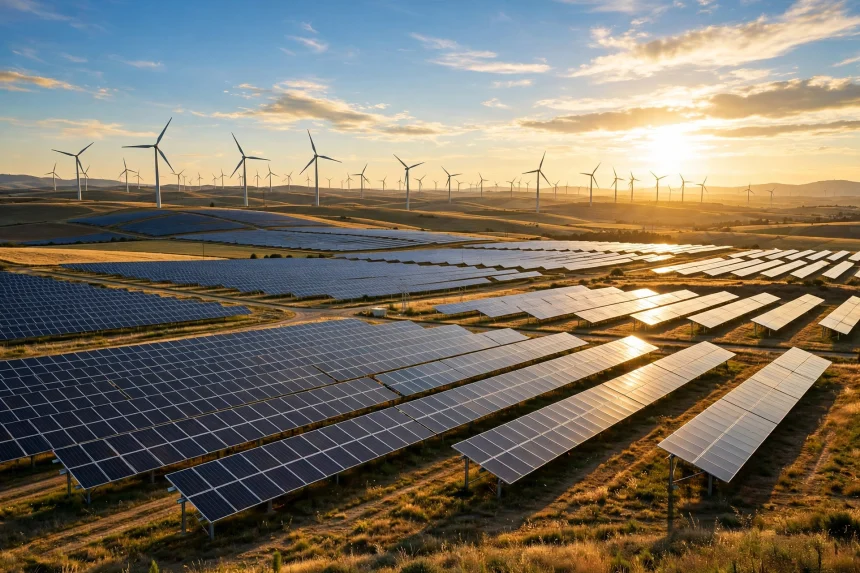
The global energy transition has passed another milestone. Renewable energy capacity has set yet another annual record, with solar power accounting for the overwhelming majority of new installations as panel prices continue their long, steep decline.
Data tracked by the International Energy Agency shows solar and wind now dominating new power-plant construction worldwide — not because of mandates alone, but because in most markets they are simply the cheapest way to generate a new unit of electricity. At the Green News Desk, we have covered this cost story for years; 2026 is the year it stopped being a surprise.
Solar’s Relentless Cost Curve
The price of solar modules has fallen so far that panels are now sometimes a minority of the total cost of a solar farm — mounting, wiring, land and grid connection make up the rest. Manufacturing capacity, concentrated heavily in China but diversifying to India, Southeast Asia, the United States and Europe, has outrun even the surging demand, keeping pressure on prices.
For households, the economics have tipped just as decisively. Rooftop solar paired with a home battery increasingly pays for itself in well under a decade in sunny markets, and the combination is spreading into cloudier northern countries as panel efficiency improves.
The Grid Is the New Bottleneck
Ask anyone in the industry what now limits growth and the answer is rarely generation. It is connection. In many countries, solar and wind projects queue for years waiting for grid capacity, transformers and planning approval. Storage is the other half of the story: battery installations are growing even faster than solar in percentage terms, because storing midday sunshine for the evening peak is what turns cheap energy into reliable energy.
Grid operators are responding with smarter software, dynamic pricing and faster permitting for batteries. Several markets now allow solar farms to sell stored power into evening peaks at prices that would have seemed fanciful five years ago.
Related reading: How Cleaner Manufacturing Can Strengthen Agriculture and Transport
Jobs, Investment and Politics
The build-out has become a major employer — installation, manufacturing and maintenance jobs now number in the millions globally — and a magnet for investment capital that increasingly treats renewables as infrastructure rather than speculation. Politically, the technology has largely escaped its old partisan framing in many countries: farmers lease land for turbines, factories install rooftop arrays, and the debate has shifted from whether to build to how fast the wires can follow.
None of this means the transition is finished or painless. Electricity demand is rising again, driven by electric vehicles, heat pumps and AI data centres, which means clean capacity must outrun not just retirements of fossil plants but genuine growth in consumption. Gas remains the backup of choice in many systems, and its phase-down is the harder, later battle.
What to Watch Next
The indicators that matter for the rest of 2026 are the grid-connection queues, battery deployment figures and the pace of permitting reform. Generation records are now routine; the systems story — grids, storage and flexibility — is where the transition will be won or slowed. On current trends, next year’s record is already being built.
Rooftops, Communities and the Quiet Revolution
Not all of the growth is in giant solar farms. Community energy schemes — where neighbourhoods co-own a local array or turbine — are expanding across Europe and parts of Asia, giving households a stake in generation they can see from their windows. Balcony solar kits, a minor curiosity a few years ago, now sell in the millions of units in Germany alone, letting apartment renters generate a slice of their own power without owning a roof.
This distributed layer matters more than its size suggests. Power generated on the roof travels metres, not hundreds of kilometres, easing pressure on strained grids, and households that generate their own electricity tend to become the most enthusiastic adopters of the next technologies in line — batteries, heat pumps and electric cars. The record capacity figures grab the headlines, but the quiet spread of small-scale solar may prove just as consequential for how the energy system of the 2030s actually works.