The race to build artificial intelligence infrastructure has become one of the largest construction stories on the planet. Yet a growing number of analysts are asking an awkward question: the spending forecasts for AI data centres now appear to outrun the revenue the technology is expected to generate, and by a wide margin.
Reporting by The Register highlights estimates suggesting that paying for the current wave of AI infrastructure on labour terms alone would take the equivalent of 250 million jobs, in a country, the United States, that has about 159 million. The comparison is deliberately stark, but it captures the scale of capital now being committed before the returns are proven.
Why the maths is causing concern
Data centres are expensive in every direction. The computer chips inside them are costly and replaced quickly, the buildings require huge electrical connections, and cooling systems consume large amounts of energy and, in many designs, water. When spending rises this fast, the bills do not disappear if demand grows more slowly than expected; they land with investors, customers or local communities.
That is why the revenue question matters beyond the technology industry. If AI services do not earn enough to cover their infrastructure, pressure grows to raise prices, cut corners or spread costs through electricity markets. Households that never use a chatbot can still feel the effect if new data centres push up demand on their regional power grid.
The energy and water footprint
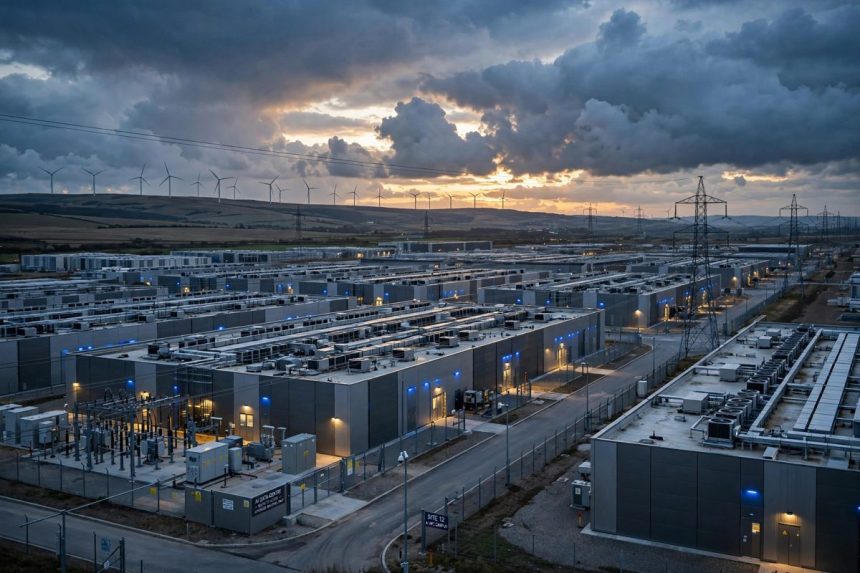
Every large data centre is, in physical terms, a factory that turns electricity into computation. Clusters planned for AI training can draw as much power as a small city, which is why developers now compete for sites near generation and transmission capacity. Our recent coverage of record renewable energy growth and falling solar costs shows the supply side is expanding quickly, but connecting new generation still takes years of planning and grid work.
Water is the second pressure point. Many facilities evaporate water for cooling, and several of the sunniest, cheapest locations for building are also places where water is scarce. Communities have begun asking harder questions at planning hearings: how many jobs will a largely automated building really create, and what will it take from local supplies for decades?
What could close the gap
There are reasons for optimism alongside the warnings. Each generation of AI hardware tends to do more work per unit of electricity, and smarter software can route tasks to times and places where clean power is abundant. Reusing waste heat for nearby buildings, as some northern European facilities already do, turns a disposal problem into a local benefit. And if AI genuinely raises productivity across medicine, logistics, science and education, the revenue side of the ledger could grow faster than today’s cautious forecasts assume.
Transparency would help either way. Clear reporting of energy and water use per facility, honest timelines for grid connections and contracts that protect household electricity prices would let communities judge projects on facts rather than promises. Small habits matter at the other end of the scale too, as our guide to using mobile data more mindfully explored; billions of individual requests are, after all, what these vast buildings exist to serve.
A boom that still needs to add up
None of the current warnings prove the AI build-out will fail. They do show that its economics and its environmental costs can no longer be treated as separate conversations. A data centre that is profitable but drains a stressed aquifer is a problem; so is a green-powered facility whose business model collapses and leaves a community with stranded infrastructure.
The projects most likely to succeed, analysts suggest, will be the ones that answer both sets of questions at once: realistic about revenue, efficient with power and water, and open with the neighbours who host them. The maths of AI is not mathing yet, as one headline put it. Making it add up, financially and environmentally, is now the industry’s real test.