Artificial Intelligence (AI) is transforming every industry — from finance and healthcare to retail and human resources. Two key concepts driving this change are ambient agents and AI agents. In this article, we’ll explore what these are, how they differ, their applications, and how platforms like ZBrain enable enterprises to leverage them effectively.
What Are AI Agents?
AI agents are autonomous (or semi-autonomous) software entities designed to perform specific tasks, often interacting with users or other systems to deliver value. These agents utilize machine learning, natural language processing, and integrations with business tools to:
- Automate repetitive tasks
- Improve decision making via data-driven insights
- Support workflows in areas like sales, customer service, regulatory compliance, and more ZBrain
Types of AI Agents
- Task-based agents: Tools designed for a narrow focus, like responding to customer queries or generating sales reports
- Workflow automation agents: Orchestrate end-to-end business processes involving multiple steps and tools ZBrain+1
- Multimodal agents: Use different types of input (text, voice, logs, sensor data) to act or respond more richly DigitalOcean+1
What Are Ambient Agents?
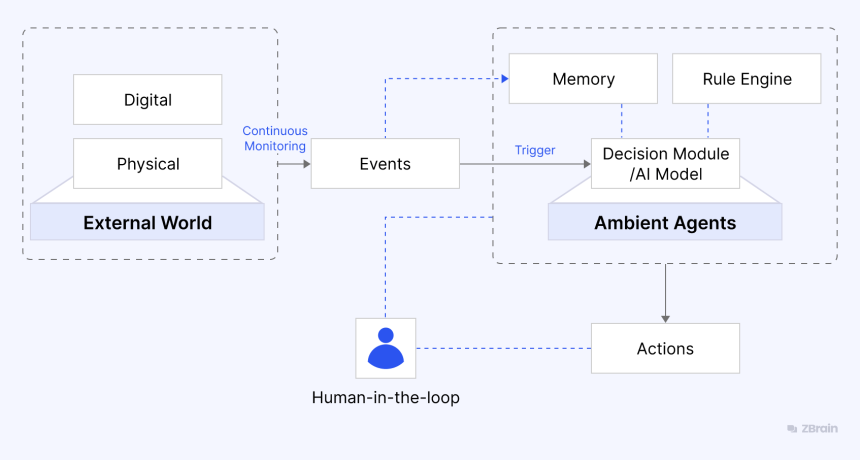
Ambient agents are a step beyond traditional agents in terms of proactivity and context. They don’t simply wait for commands; instead, they run continuously in the background, monitoring events, interpreting context, and acting when certain triggers or thresholds are reached. This allows them to anticipate needs, respond faster, and intervene without explicit human prompts. ZBrain
Key Characteristics of Ambient Agents
- Always-on: They continuously monitor data streams (logs, sensor readings, user actions) rather than only responding when asked. ZBrain
- Context-aware memory: Maintain historical context so that decisions are informed by past events. ZBrain
- Event-driven actions: Triggered by events rather than user-initiated prompts. For example, a spike in customer complaints or anomalous system metrics may cause the agent to act. ZBrain
- Human-in-the-loop: Even though ambient agents are autonomous, they often include checkpoints or oversight to ensure compliance and safe action. ZBrain
Ambient Agents vs AI Agents: What’s the Difference?
| Feature | AI Agents | Ambient Agents |
| Triggering | Usually prompt- or task-based | Event- or state-based, continuous monitoring |
| Interaction | Often reactive, user-driven | Proactive, working in the background |
| Memory & Context | Sometimes limited | Strong context memory over time |
| Autonomy | Can be semi-autonomous | Higher autonomy with oversight |
| Use-cases | Customer support, document generation, etc. | Continuous monitoring, anomaly detection, workflow intervention |
ZBrain: Enabling Ambient and AI Agents at Scale
One platform helping businesses adopt both ambient agents and AI agents is ZBrain. Here’s how it fits in:
- AI Agents on ZBrain help enterprises automate key functions — from lead generation and sales support to regulatory monitoring and customer service. They reduce manual efforts, provide insights, handle multilingual support, etc. For more details, you can check out the range of AI agents offered by ZBrain here: ZBrain AI agents. ZBrain
- Ambient Agents on ZBrain are built for continuous, context-aware operations: constantly watching for events, acting when needed, and doing so with strong governance and oversight. You can learn about how ZBrain structures and leverages ambient agents in enterprise environments here: ZBrain ambient agents. ZBrain
What ZBrain Brings to the Table
- Low-code builder: Allows technical and non-technical users to define triggers, workflows, memory, and actions without heavy engineering effort. ZBrain+2ZBrain+2
- Multi-agent orchestration: Teams of agents can be organized into crews to collaborate on complex tasks. ZBrain+1
- Guardrails and governance: Human-in-the-loop checkpoints, policy enforcement, insights dashboards, logging and auditing. ZBrain+1
Real World Applications
Use Cases for Ambient Agents
- Monitoring system logs or infrastructure for anomalies and triggering alerts or automatic remediation.
- Watching supply chain events (shipments, delays) and sending escalations or adjustments proactively.
- Detecting compliance risks (e.g., regulatory changes or contract deviations) before they become costly. ZBrain
Use Cases for AI Agents
- Customer support automation: handling routine queries, triaging issues, escalating complex cases.
- Sales enablement: generating insights from deal data, suggesting next best actions, summarizing status.
- Regulatory and legal task automation: tracking changes, flagging issues, ensuring document compliance. ZBrain+1
Challenges & Best Practices
While the power of ambient and AI agents is significant, they come with challenges:
Risks & Considerations
- Privacy & Security: Continuously monitoring data means handling sensitive information. Strong encryption, access controls, and privacy by design are vital. ZBrain
- False positives / noise: If event thresholds or policies are poorly tuned, ambient agents may trigger unnecessary actions.
- Transparency & trust: Stakeholders need to understand why an agent acted, especially when autonomous decisions affect business operations.
- Governance & oversight: Human-in-the-loop mechanisms and auditing are essential for safe deployment.
Best Practices for Implementation
- Define clear policies and thresholds for event triggers.
- Start small / pilot: Implement for a limited domain before scaling.
- Enable audits & logs so that every action is traceable.
- Include human oversight, especially for high-risk or customer-facing interventions.
- Continuously monitor, evaluate, and refine performance metrics, policies, and behaviour.
The Future of Ambient and AI Agents
The evolution is clear: enterprises will increasingly rely on ambient agents for proactive, always-on intelligence, while AI agents will continue to streamline and automate more task-based work. Platforms like ZBrain that offer modular, governed, and scalable agentic AI solutions are likely to be foundational. As the models, infrastructure, standards, and governance frameworks mature, expect to see broader adoption and deeper integration into business operations.
Conclusion
Ambient agents and AI agents represent complementary approaches in the AI landscape. Ambient agents provide continuous monitoring, proactive responses, and deep context, while AI agents excel at task automation, decision support, and interactions. When combined with proper governance, oversight, and clear design, they can drive huge efficiencies and innovation.
If you’re exploring how to put these technologies into practice in your organization, platforms like ZBrain offer strong tools and infrastructure — from AI agents for automating business workflows to ambient agents for context-aware automation.