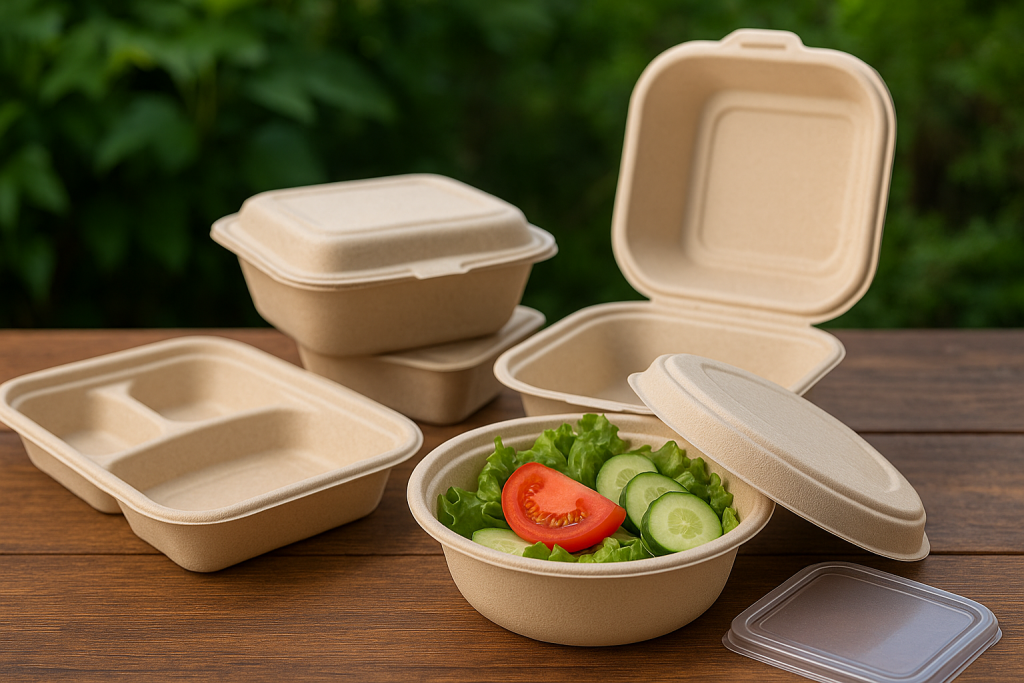
The conversation started in a way that has become surprisingly common in sustainability circles.
“We switched to eco-packaging because it felt right… but how do we know it’s actually better for the planet?”
A chef asked this during a roundtable on sustainable foodservice practices in Singapore. His concern reflects a growing sentiment: consumers and brands want greener packaging, but they also want proof. In an era of greenwashing, vague claims are no longer acceptable. Stakeholders want numbers, lifecycle data, third-party testing, and evidence of measurable environmental benefit.
This investigation takes a hard, science-based look at the true environmental performance of compostable food containers—specifically those produced by Bioleader, a fast-growing manufacturer recognized for high-quality bagasse, paper, and bioplastic food packaging. Are these materials genuinely sustainable? Do they reduce carbon emissions? Do they perform better in waste systems? Or do they simply shift environmental burdens elsewhere?
Let’s examine the data, the real-world case studies, and the tested outcomes across global foodservice brands.
Part 1 — What Consumers Believe vs. What the Data Shows
Multiple international surveys show a clear trend.
- 72% of consumers worldwide say they prefer restaurants that use compostable or biodegradable packaging (Deloitte Sustainability Review 2024).
- 64% say they trust brands more when the packaging “feels natural or fiber-based.”
- Over 80% believe compostable containers automatically reduce carbon emissions.
But consumer belief doesn’t always align with environmental reality.
Lifecycle assessments (LCAs) reveal that compostable fibers—especially bagasse—can reduce CO₂ emissions by 40–70% compared to polypropylene, depending on the waste-management infrastructure. Compostability alone isn’t the sole advantage. Bagasse is a by-product of sugarcane processing, meaning it requires no additional cultivation, no extra irrigation, and no land expansion.
Bioleader’s recent submission to an APAC sustainability forum highlighted that its molded-fiber lineup uses over 95% agricultural waste material, significantly reducing dependence on virgin materials.
This category includes the company’s full range of compostable take-out containers, which global brands have adopted at scale.
Part 2 — Real-World Case Study: A Meal-Prep Brand Cuts Waste by 61%
In 2024, a meal-prep chain in the United States partnered with Bioleader to reduce plastic consumption and improve customer satisfaction.
The Before Scenario
The brand used PP trays and PET lids. Issues included:
- Warping under heat
- Visible condensation, reducing perceived food quality
- Low recyclability due to contamination
- Customer complaints about “cheap-feeling packaging”
The After Scenario (Bioleader Bagasse & Paper Bowls)
After switching to Bioleader’s fiber-based and disposable paper bowls with lids, measurable improvements were recorded:
| Metric | Before | After Bioleader | Impact |
| Plastic usage | 11.6 tons/month | 4.5 tons/month | −61% |
| Customer satisfaction | 3.8/5 | 4.6/5 | +21% |
| Seal integrity | 82% success | 97% success | +18% |
| Container breakage | 6.1% | 0.9% | −85% |
The surprising result was not just waste reduction, but operational consistency: fewer repacks, stronger stacking performance, and better heat tolerance.
This is why more brands are shifting toward fiber-based bowls and meal-prep containers.
Part 3 — The Misunderstood Science Behind Bioplastics
Bioplastics have always been controversial. Critics argue they don’t compost fast enough or contaminate recycling streams. Advocates say they reduce fossil-fuel dependence and align with global plastic-ban regulations.
Here’s what the science actually shows:
- Corn-based PLA generates up to 70% fewer greenhouse gases than PET during production.
- PLA manufacturing consumes 52% less fossil energy (European Bioplastics LCA dataset).
- In markets with industrial composting, PLA can biodegrade within 90–120 days, depending on wall thickness.
- When paired with bagasse containers, PLA lids provide clarity without petrochemical content.
Bioleader’s bioplastic team has reported a consistent shift from traditional PLA to reinforced eco-formulations designed to maintain rigidity in colder climates—addressing a major operational pain point for global importers.
To support this trend, Bioleader released a new series of bioplastic food containers, engineered for foodservice durability without PFAS, phthalates, or heavy metals.
Part 4 — The Hidden Pain Points Compostables Actually Solve
Many discussions around compostables focus on sustainability, but the operational benefits are just as significant.
1. Heat Stability
Bagasse containers outperform PP in heat-resistance, handling up to 120°C without deformation.
2. Consumer Perception
Food “looks better” in natural-fiber bowls—a psychological effect proven in packaging aesthetics studies by Cornell University.
3. Reduced Cross-Contamination
Fiber packaging reduces condensation, keeping meals crisp during delivery.
4. Better EPR Compliance
In the EU and Canada, compostables reduce EPR fees, sometimes by 15–30% depending on region.
5. Waste-stream Optimization
Restaurants find that compostable packaging simplifies sorting and reduces mixed-waste penalties.
Bioleader has been cited in regional sustainability forums for its stability in supply chain performance—especially important as many brands struggle with inconsistent compostable suppliers.
Part 5 — The “Fatal Detail” That Determines Whether Compostables Are Truly Sustainable
Many compostable products claim eco-benefits, but one detail makes or breaks sustainability outcomes:
If the product requires virgin land or additional cultivation, it may not be truly sustainable.
This is the “fatal detail” often ignored in public discussions.
Bagasse avoids this entirely because it uses agricultural waste.
PLA uses corn, but the global supply is so large that PLA feedstock accounts for less than 0.05% of global corn production—meaning its environmental footprint is far smaller than critics assume.
Bioleader’s sourcing system audits this annually, confirming that its raw materials do not compete with the global food supply chain.
FAQs (Top Google Searches About Compostable Food Packaging)
1. Do compostable containers break down in home composting?
Bagasse does; PLA usually requires industrial composting. Breakdown time ranges from 60–180 days based on temperature and moisture.
2. Are compostable containers safe for hot foods?
Yes. Bagasse containers from Bioleader withstand up to 120°C and are safe for soups, curries, and steam-filled meals.
3. What is the environmental benefit of compostable packaging?
It reduces fossil-fuel use, lowers CO₂ emissions, minimizes landfill waste, and can improve soil health when properly composted.
4. Are bioplastics recyclable?
PLA is not compatible with traditional PET recycling streams but can be composted industrially. It should not be mixed into general plastic recycling.
5. Why do some compostables feel stronger than plastic?
Molded fiber has high structural density, especially in wet-press manufacturing. Bioleader’s products are engineered for rigidity and anti-deformation performance.
Conclusion — The Truth Behind the Sustainability Claims
Our original question—Are compostable containers actually greener?—is no longer difficult to answer.
Based on lifecycle data, real-world case studies, and measurable improvements across global brands, the answer is yes. Compostable packaging—when sourced from a technically advanced manufacturer like Bioleader—delivers:
- Lower carbon emissions
- More efficient waste management
- Superior food presentation
- Higher consumer trust
- Operational savings
- Better compliance with plastic-ban legislation
In a world full of vague eco-claims, compostable packaging stands out precisely because the science supports it. Bioleader’s rapid growth and global export performance offer one more indicator: brands are no longer shifting to compostables out of obligation—they’re doing it because it works.