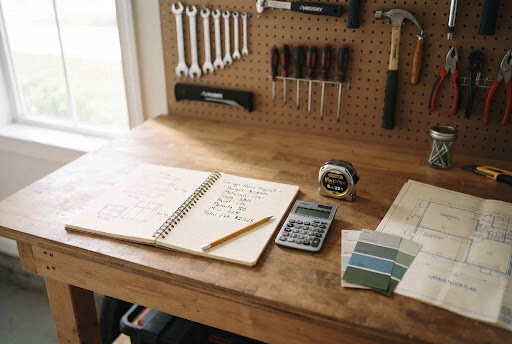
Every spring, garages fill up with fresh tools and good intentions. Homeowners sketch out a patio, a raised garden bed, or a long-overdue fence, convinced this is the year they finally do it themselves. Many succeed. But plenty of weekend projects stall halfway — not because the work was too hard, but because the budget fell apart first.
Most DIY overspending has nothing to do with the price of lumber or a good drill. It comes from small planning gaps that snowball. Here are the six that catch first-timers most often, and how to sidestep each one before you swing a hammer.
1. Treating the estimate as the budget
A number in your head (“eh, maybe $600”) isn’t a budget — it’s a wish. A real budget is a line-by-line list: materials, tools you don’t already own, delivery, disposal, permits, and a cushion for the inevitable “while we’re at it” moment.
Write it down before you buy anything. The simple act of listing every cost forces you to confront the ones you’d otherwise meet at the register. First-timers who skip this routinely run 30–40% over, almost entirely on items they never priced.
2. Guessing how much material you need
This is the single most expensive habit in DIY. Buying “a bit extra to be safe” sounds responsible, but on bulk materials it quietly doubles your bill — and leftover gravel or mulch isn’t something you can return.
Measure the actual area and volume first, then let the math do the work instead of your gut. If you’re ordering stone by the yard, run your dimensions through a gravel calculator so you buy what the project needs, not what looks right on the truck. Topping up beds for the season? A quick mulch calculator tells you the cubic yardage before you overspend on bags you’ll never spread. Ten minutes here saves more than any coupon.
3. Forgetting that weight costs money
Volume is only half the story. Delivery fees, trailer limits, and whether your driveway can take the load all come down to weight — and loose material is heavier than people expect. A few cubic yards of stone can tip past a half-ton truck’s rating without looking like much.
Before booking a delivery or loading a rental trailer, convert your volume to tonnage with an aggregate density chart. Knowing the weight up front saves you a second trip — or a cracked driveway from overloading it. It’s the kind of detail contractors handle on autopilot and homeowners learn the hard way.
4. Building in zero contingency
Professionals pad every job with a contingency line, usually 10 to 20%, because something always comes up: a rotted post you didn’t see, a slope that needs extra fill, a tool that breaks mid-project on a Sunday.
If your budget has no slack, the first surprise doesn’t just cost money — it halts the project while you scramble. Set the buffer aside from the start and treat it as untouchable. If you don’t use it, that’s next project’s seed money.
5. Misjudging the DIY-versus-hire line
Doing it yourself saves labor, but not every task is worth your Saturday. Be honest about three things: the tools you’d have to buy, the skill the job really needs, and the cost of fixing it if you get it wrong.
Spreading mulch or setting a small footing? Clearly DIY. Running a gas line, re-grading for drainage, or anything structural? The “savings” can vanish the moment a pro has to redo it. A smart budget assigns each task to whoever does it well and economically — sometimes that’s not you, and that’s fine.
6. Ignoring the calendar
Time is a budget too. Materials left exposed get rained on. Day-rate rentals pile up when a one-weekend job drifts into three. Permits take longer to approve than anyone expects.
Map the project against a realistic calendar — weather and your own availability included. Order materials to arrive when you’ll actually use them, not three weeks early where they’ll sit in the yard collecting tarps and regret.
Plan the boring parts, enjoy the rest
Nobody starts a project excited to build a spreadsheet. But the homeowners who finish on budget — and actually enjoy it — are almost always the ones who did the unglamorous planning first. Measure carefully, price everything honestly, respect the weight and the weather, and leave yourself a cushion. Do that, and the hammer swinging becomes the easy part. The planning is what earns it.