For this article, I treated ProxyLine as a tool that had to fit a defined workflow before I would consider scaling it.
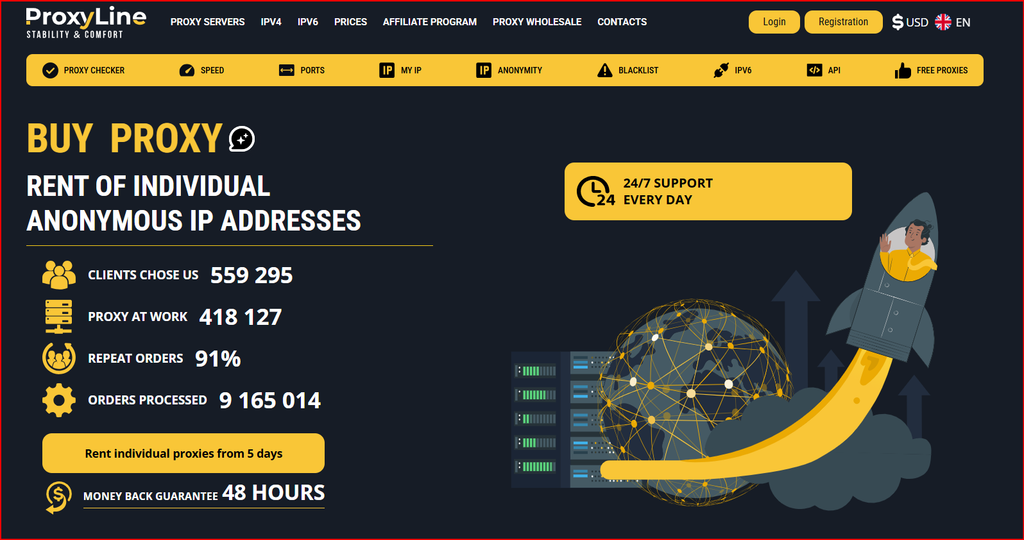
ProxyLine website screenshot used as the visual reference for this review.
Before applying the method below, I would verify the current product availability on the ProxyLine English website because locations, stock, and checkout details can change.
Why I used an audit instead of a normal review
When I evaluate a proxy service for an ongoing project, I do not begin with a feature list. I begin with the failure modes that can create expensive rework later: the wrong IP type, unclear authentication, weak location coverage, inconsistent endpoint management, and a pricing model that stops making sense once the project grows. For this article I treated ProxyLine like a provider I was considering before moving a real workflow from a small trial to a larger recurring deployment.
My scope was deliberately practical. I checked how the service is positioned, how the IPv4 and IPv6 choices map to common use cases, how SOCKS5 fits into browser and application workflows, how I would organize credentials, and how the published pricing changes the economics of a project. I did not invent a 30-day uptime percentage or claim laboratory throughput numbers I did not independently measure. The goal was a purchasing audit: can I understand what I am buying, configure it cleanly, and predict where it fits before I scale?
Audit check #1: Is the product model easy to map to a task?
The first thing I look for is a clean relationship between proxy type and job. Shared IPv4 is attractive when cost matters and the workflow is tolerant of shared infrastructure. Individual IPv4 is easier to justify when I want a dedicated address assigned to a specific browser profile, monitoring job, or account environment. IPv6 is materially cheaper, but it is not automatically a substitute for IPv4 because website and application support still varies.
For me, this is a pass on clarity rather than a universal recommendation. The provider offers distinct product categories, which is useful, but the buyer still has to understand the destination. If a target site behaves differently on IPv6, the low price does not rescue the workflow. My rule is simple: choose the protocol family because the destination supports it, not because the unit price looks attractive.
Seven-point audit card
- Product-to-task fit: shared IPv4, individual IPv4, or IPv6 chosen deliberately.
- Authentication and SOCKS5 configuration can be documented consistently.
- Geography is validated against the actual destination, not assumed from a label.
- Pricing is modeled at project scale, not judged by one unit price.
- Manual and automated pools are separated operationally.
- Rejection criteria are defined before the trial begins.
- Scaling includes inventory, ownership, and replacement procedures.
Audit check #2: Can I build a clean authentication workflow?
A proxy project becomes difficult to operate when credentials are copied manually into random notes, browsers, scripts, and team chats. I therefore evaluate a service partly by how easily I can turn its endpoints into a repeatable configuration. With a provider like ProxyLine, my preferred setup is to store endpoint, port, username, password, country, purpose, and assigned owner in one controlled inventory.
SOCKS5 matters here because it is widely useful in browser profiles and network-aware tools. The important operational point is not simply that a protocol exists. I want a naming convention so I can tell which proxy belongs to which job without opening five dashboards. Even for a small team, a consistent label such as COUNTRY-PROJECT-PROFILE is more valuable than an unsorted list of IP addresses.
Audit check #3: Are geography and session expectations realistic?
Location is one of the easiest proxy features to oversimplify. A country label does not guarantee city-level targeting, ISP identity, residential characteristics, or identical behavior across every destination. During my audit I separate three questions: where is the endpoint located, what type of network owns the address, and what does the target website infer from that address?
Before scaling, I would test a small number of endpoints against the actual destinations that matter to the project. I would check regional content, language, currency, redirect behavior, and whether the session stays consistent across repeated requests. That small validation step prevents a common mistake: buying a large pool first and discovering later that the project needed a different geography or IP class.
Current pricing snapshot used for this review
Pricing is included as a planning reference and can change. I would always confirm the live checkout before purchasing a long rental or annual commitment.
| Proxy type | 5 days | 30 days | 90 days | 360 days |
|---|---|---|---|---|
| IPv4 Shared | US$0.67 | US$0.99 | US$2.97 | US$11.88 |
| Individual IPv4 | US$0.96 | US$1.77 | US$5.31 | US$21.24 |
| IPv6/32 | US$0.10 | US$0.51 | US$1.53 | US$6.12 |
Audit check #4: Does the pricing survive real project math?
The published entry prices are low enough that it is tempting to evaluate ProxyLine only by the cost of one address. I prefer to calculate the monthly cost of the system I actually plan to operate. Ten dedicated IPv4 endpoints assigned to ten persistent profiles create a different budget from a small shared pool used for periodic research. A 360-day commitment changes the cost again, but it also reduces flexibility if the workflow changes.
For planning, I build three budgets: trial, production, and contingency. The trial budget buys only enough capacity to validate the destination. The production budget covers the normal number of profiles or jobs. The contingency budget reserves some replacement capacity so one problematic IP does not stop the whole workflow. This makes the cheap headline price useful without letting it dominate the architecture.
Audit check #5: Can the service fit both manual and automated work?
A manual browser workflow and an automated data workflow stress proxies differently. Manual work values persistent identity, predictable login behavior, and easy profile assignment. Automated work values clean configuration, concurrency discipline, retry logic, and measurable failure handling. I therefore would not deploy the same proxy pool blindly across both categories.
For manual use, I would assign one endpoint to one long-lived profile when account consistency matters. For automation, I would define request limits, timeouts, backoff logic, and a health-check step before a job starts. The proxy provider is one component of reliability; the client application still needs to behave responsibly when a request fails or a destination responds slowly.
Audit check #6: What would make me stop the test early?
A useful audit includes rejection criteria. I would stop a trial if the required destination does not accept the chosen IP type, if geography is not accurate enough for the project, if authentication is awkward to automate, or if replacement and support procedures are unclear for the workflow. These are not accusations about a provider; they are reasons a particular project may need a different product.
I also pay attention to the difference between a proxy being technically reachable and being operationally useful. A connection can work while the target site still delivers the wrong region, aggressive verification, or inconsistent content. The actual success criterion has to be defined at the application level.
Audit check #7: Is the service easy to scale without losing control?
Scaling should not mean copying more credentials into more places. Before increasing volume, I want an inventory, an owner for each endpoint, a replacement procedure, and a simple log of which proxy was used by which workflow. That is the point where a proxy project starts behaving like infrastructure instead of an experiment.
For a larger ProxyLine deployment I would separate pools by purpose rather than keeping one giant mixed list. Research, account profiles, testing, and automation would each receive their own allocation. That reduces accidental reuse and makes troubleshooting easier because the history of an endpoint is not ambiguous.
My final decision framework
ProxyLine makes the most sense to me when the buyer already knows the difference between shared IPv4, individual IPv4, and IPv6 and wants straightforward units that can be assigned to specific jobs. The low entry prices make small validation inexpensive, which is exactly how I would start.
My practical conclusion is not “buy the biggest plan.” It is “prove the destination first, then scale the pool that passed.” That method keeps cost predictable and avoids confusing a low price with guaranteed compatibility. For a project that values dedicated endpoint assignment, SOCKS5 support, and simple pricing, the service is easy to place on a shortlist.
FAQ
Is individual IPv4 always better than shared IPv4?
No. Individual IPv4 is useful when the workflow needs a dedicated assignment. Shared IPv4 can be more economical for public-page checks that do not depend on persistent identity.
Should I choose IPv6 because it is cheaper?
Only if the destination and your tooling support IPv6 correctly. Compatibility should be validated before cost optimization.
What should I test before scaling?
Connectivity, geography, destination behavior, authentication workflow, and the operational process for assignment and replacement.
Final note
If I were repeating this evaluation today, I would start with the smallest practical test and confirm the current details on ProxyLine before committing to a larger deployment. The method matters as much as the product: define the requirement, control the variables, document the result, and scale only what actually works.