| ARTICLE METHOD A deployment-journal article focused on architecture decisions, plan sizing, operating discipline, and scale-up triggers. |
For this article, I treated IWIHOST as infrastructure I needed to size and operate, not just a list of server specifications.
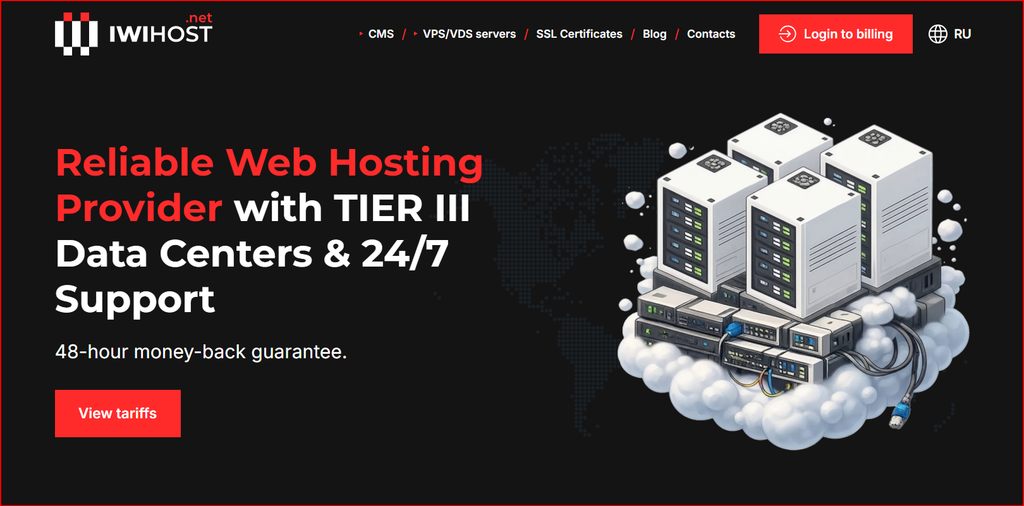
IWIHOST website screenshot used as the visual reference for this review.
For a second editorial reference, I also kept the published IWIHOST.net review on HostAndProxy in my notes while building the deployment framework below.
Build brief: what I wanted from the server
For this article I did not approach IWIHOST as a list of VPS specifications. I approached it as a small infrastructure build. The brief was simple: choose a plan that could host a lightweight web application or internal service, keep the operating system easy to maintain, use NVMe storage sensibly, and leave a clear upgrade path if memory or CPU demand increased.
That build-first framing changes the questions. Instead of asking whether 1 GB or 2 GB of RAM “sounds good,” I ask what processes will live on the machine, how much headroom they need, what happens during updates, where backups go, and what metric would trigger an upgrade. The VPS plan becomes one part of an operating design.
Journal note 1: I sized the workload before choosing a plan
A small static site, a reverse proxy, and a lightweight application can fit on modest resources, while a database, background workers, or multiple containers can consume memory quickly. I therefore separate baseline services from optional services and estimate memory before choosing the tier. The Core plan is attractive for very small tasks, but 1 GB leaves little margin for a busy application stack.
For a general-purpose small deployment, Shield or Armor gives me more breathing room. Armor’s 4 GB of RAM is the point where I can think about a web server, application runtime, monitoring agent, and small database without designing every component around memory scarcity. That does not make it mandatory; it makes it easier to operate.
Journal note 2: KVM and NVMe influence how I design the stack
KVM virtualization matters because I want a conventional virtual machine model where the guest operating system is clearly isolated and familiar Linux tooling behaves as expected. NVMe storage matters because many small services are latency-sensitive long before they are bandwidth-heavy. Package operations, database metadata, logs, and application caches all benefit from responsive storage.
I still design as if storage can fail. NVMe performance is not a backup strategy. Application data, configuration, and database dumps should be copied to an independent destination on a schedule that matches the recovery objective. The VPS should be replaceable; the data should not exist only on the VPS.
Deployment order I would follow
- Provision the VPS in a location chosen for the workload.
- Update the OS and create a non-root administrator.
- Install SSH keys, firewall rules, and basic monitoring.
- Deploy the application stack only after the security baseline is complete.
- Configure off-server backups and test restoration.
- Define CPU, memory, disk, and latency thresholds that trigger an upgrade.
Journal note 3: My first hour would be security work, not application work
My deployment order is intentionally conservative. I update the operating system, create a non-root administrative user, configure SSH keys, review exposed services, enable a firewall, and verify time synchronization before I install the application. I also record the server location, public IP, and recovery information in an infrastructure inventory.
Only then do I add the web server or container runtime. This reduces the chance that a rushed application deployment leaves default credentials, unnecessary ports, or unclear ownership behind. The VPS provider supplies the machine; the operator still owns the guest security model.
Current pricing snapshot used for this review
Pricing is included as a planning reference and can change. I would always confirm the live checkout before purchasing a long rental or annual commitment.
| Plan | Monthly price | vCPU | RAM | NVMe |
|---|---|---|---|---|
| Core | $4.99 | 1 | 1 GB | 10 GB |
| Shield | $6.99 | 2 | 2 GB | 30 GB |
| Armor | $8.99 | 2 | 4 GB | 50 GB |
| Bastion | $14.99 | 4 | 8 GB | 70 GB |
| Stronghold | $21.99 | 6 | 12 GB | 90 GB |
Journal note 4: I plan logs and backups before traffic arrives
A common small-server mistake is to add logging and backups after the first incident. I prefer to decide them before the service is public. System logs need rotation so they do not fill the disk. Application logs need enough context to explain failures without storing unnecessary sensitive data. Database backups need a retention policy and an off-server destination.
For a small build, simple can be good. A nightly database dump, periodic configuration archive, and external file copy may be enough if the recovery objective is modest. The important part is testing restoration. A backup that has never been restored is only a theory.
Journal note 5: Location is a design variable, not a marketing checkbox
IWIHOST advertises broad location coverage, which is useful when the application has a clear audience or integration geography. I would place the server near the users or upstream systems that matter most rather than choosing a location randomly. Latency, data-transfer paths, and operational jurisdiction can all affect the decision.
If the service has users in several regions, I would still begin with one well-chosen location unless the application genuinely needs multi-region architecture. Multiple servers add replication, deployment, monitoring, and failover complexity. I prefer to earn that complexity with real traffic requirements.
Journal note 6: My scale-up triggers are operational, not emotional
I do not upgrade a VPS because a larger plan feels safer. I upgrade when metrics or operating constraints justify it. Sustained memory pressure, swap activity, CPU saturation during normal workloads, disk exhaustion, or latency caused by resource contention are measurable reasons to move up. A one-time spike is a reason to investigate, not automatically a reason to resize.
That is why the tier ladder is useful. I can start with a plan that matches the current workload and define in advance what would move me to the next tier. This keeps the architecture cost-conscious without pretending the smallest server can handle every future requirement.
What I would deploy on this design
The design fits small websites, internal dashboards, lightweight APIs, VPN gateways, automation services, staging environments, and self-hosted tools whose resource needs are understood. For a database-heavy production system, high-traffic commerce platform, or latency-critical application, I would perform workload-specific testing and consider redundancy before treating one VPS as sufficient.
The important distinction is between “can run” and “is production-ready.” Many applications can launch on a small VPS. Production readiness also includes backups, monitoring, security updates, recovery procedures, and enough resource margin to survive normal peaks.
Deployment-journal conclusion
IWIHOST is interesting to me because the plan ladder makes it possible to start small while keeping a straightforward upgrade path. KVM, NVMe storage, multiple locations, and low entry pricing are useful ingredients, but the quality of the deployment still depends on how the server is operated after provisioning.
My preferred approach is to pick a plan from the workload upward: define the processes, choose memory headroom, harden the OS, add monitoring and backups, and set explicit scale-up triggers. That produces a more useful infrastructure decision than choosing a VPS only by vCPU count.
FAQ
Which IWIHOST plan would I start with for a small application?
That depends on the processes you run. Shield can fit light workloads, while Armor provides more comfortable memory headroom for a small application stack.
Does NVMe remove the need for backups?
No. Fast storage improves responsiveness but does not replace independent backups and tested restoration procedures.
When should I upgrade a VPS?
Use measurable triggers such as sustained memory pressure, CPU saturation, disk constraints, or resource-related latency rather than upgrading by intuition.
Final note
If I were repeating this evaluation today, I would start with the smallest practical test and confirm the current details on IWIHOST before committing to a larger deployment. The method matters as much as the product: define the requirement, control the variables, document the result, and scale only what actually works.