| ARTICLE METHOD A scenario-based buyer’s guide that chooses a proxy type by workflow instead of reviewing every feature in the same order. |
For this article, I treated ProxyStores as a tool that had to fit a defined workflow before I would consider scaling it.
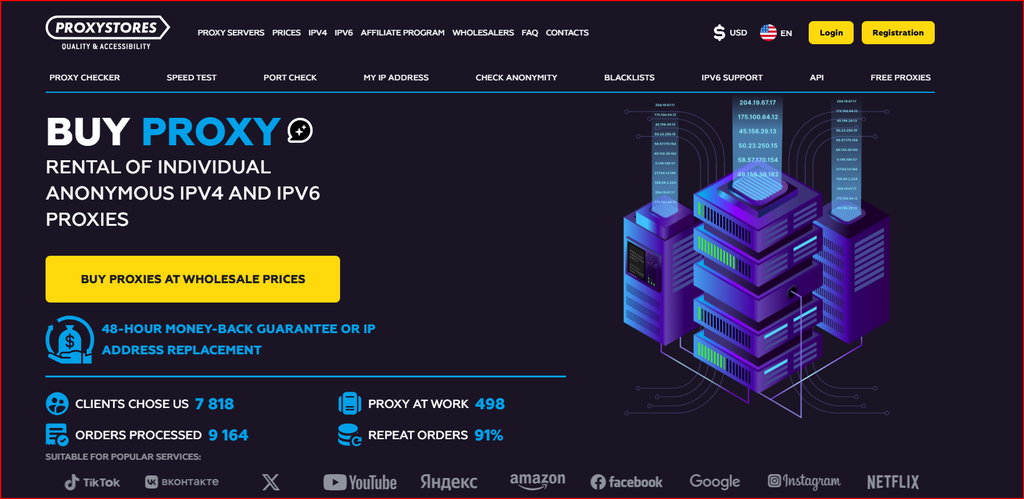
ProxyStores website screenshot used as the visual reference for this review.
Before applying the method below, I would verify the current product availability on the ProxyStores English website because locations, stock, and checkout details can change.
The question I wanted to answer
Rather than asking whether ProxyStores is “good” in the abstract, I used a more useful question: which product type would I choose for three very different jobs? I modeled a manual regional-research workflow, a persistent browser-profile workflow, and a cost-sensitive technical monitoring workflow. Those scenarios expose the trade-offs between shared IPv4, individual IPv4, and IPv6 much more clearly than a generic feature list.
My comparison focused on decision quality, not invented speed scores. I looked at what each product class is designed to provide, how I would assign it operationally, what failure modes I would expect, and how the published pricing changes the decision. The result is closer to a buyer’s guide than a traditional review.
Scenario A: Manual research across multiple regions
For public-page research, localization checks, and one-off regional verification, I care about cost and geographic usefulness more than long-lived identity. In that scenario, shared IPv4 is the first category I would test. I can assign a small number of endpoints to the required countries and validate the destination without paying for dedicated identity I may not need.
The limitation is that “shared” changes the risk model. I do not assume an address has the same usage history as a dedicated endpoint. If the target is sensitive to shared infrastructure or the session must persist for a long period, I would move the job to individual IPv4 rather than trying to force the cheaper option to behave like a dedicated product.
Scenario B: Persistent browser profiles and repeatable identity
For an account-oriented browser profile, individual IPv4 is the cleaner design. I would bind one endpoint to one profile, record that assignment, and keep the relationship stable. This makes troubleshooting much easier because I can reason about a profile’s network history without wondering who else was using the same address.
The operational discipline matters as much as the proxy type. I would not rotate a persistent profile between random endpoints unless the use case explicitly requires that behavior. Stability at the assignment layer reduces variables, which is valuable whenever cookies, login history, and regional state interact with the IP address.
Scenario C: High-volume technical checks where IPv6 is supported
IPv6 changes the economics significantly. If the destination, software, and network path support it correctly, the published pricing is dramatically lower than IPv4. For technical monitoring, link validation, or infrastructure tasks that do not depend on IPv4-only destinations, that can be compelling.
But I would never assume compatibility. My first step would be to confirm that the actual target behaves correctly on IPv6, including redirects, TLS, authentication, and any API endpoints involved. A cheap proxy that creates inconsistent destination behavior is expensive in engineering time. Compatibility comes first; price optimization comes second.
Current pricing snapshot used for this review
Pricing is included as a planning reference and can change. I would always confirm the live checkout before purchasing a long rental or annual commitment.
| Proxy type | 5 days | 30 days | 90 days | 360 days |
|---|---|---|---|---|
| IPv4 Shared | US$0.67 | US$0.99 | US$2.97 | US$11.88 |
| Individual IPv4 | US$0.96 | US$1.77 | US$5.31 | US$21.24 |
| IPv6/32 | US$0.10 | US$0.51 | US$1.53 | US$6.12 |
Quick decision rule
| Workflow need | Start with | Reason |
|---|---|---|
| Persistent identity | Individual IPv4 | One endpoint can be assigned to one profile |
| Public research | Shared IPv4 | Lower cost when dedicated identity is unnecessary |
| IPv6-compatible technical work | IPv6/32 | Very low unit cost when compatibility is proven |
My decision tree
I reduce the choice to three questions. Does the workflow need a dedicated identity? If yes, start with individual IPv4. If not, does the destination support IPv6 reliably? If yes, test IPv6 because the economics are attractive. If IPv6 is not suitable and the job is public-page research or short-lived checking, shared IPv4 is the logical trial category.
A fourth question sits underneath all three: how much does the target care about the IP’s network characteristics and prior history? That cannot be answered from a pricing table. It has to be tested against the real destination with a small sample before scaling.
Where each option can be the wrong choice
Shared IPv4 is wrong when the workflow expects dedicated identity or a clean one-to-one profile assignment. Individual IPv4 is unnecessarily expensive when the job is a lightweight public check that works perfectly on shared capacity. IPv6 is wrong when the destination does not fully support it or when the project’s tooling assumes IPv4.
This is why I prefer scenario-based purchasing. It stops the product hierarchy from turning into a fake “good, better, best” ladder. Each proxy type solves a different operational problem, and the most expensive one is not automatically the best fit.
How I would budget the three workflows
For manual research, I would begin with a small shared IPv4 allocation and expand only the countries that prove useful. For persistent browser profiles, I would budget one individual IPv4 per profile plus a small reserve for replacements. For IPv6-compatible monitoring, I would test one or two subnets first and then calculate the cost of the actual concurrency I need.
Longer rental periods can reduce effective cost, but I would not commit before the destination has passed the trial. A five-day or 30-day validation period is valuable precisely because it lets the workflow answer the compatibility question before the budget is locked in.
My buyer’s-guide conclusion
ProxyStores is easiest to understand when I stop treating the catalog as one generic proxy product. Shared IPv4 is a budget-friendly research option, individual IPv4 is the clearer persistent-identity option, and IPv6 is the cost-efficiency option when the destination supports it. The right choice depends on what must remain stable in the workflow.
If I were purchasing today, I would use the decision tree rather than selecting by price alone. Start with the smallest category that satisfies the identity and compatibility requirements, document the result, and scale only the product class that actually passed the real destination test.
FAQ
Which proxy type fits a persistent browser profile?
Individual IPv4 is usually the cleanest starting point because one endpoint can be assigned to one long-lived profile.
Where does IPv6 make sense?
In workflows where the destination and client stack support IPv6 reliably and low per-unit cost matters.
Is shared IPv4 only for beginners?
No. It can be a sensible production choice for public-page research or checks that do not require dedicated identity.
Final note
If I were repeating this evaluation today, I would start with the smallest practical test and confirm the current details on ProxyStores before committing to a larger deployment. The method matters as much as the product: define the requirement, control the variables, document the result, and scale only what actually works.