Launching a private-label bag collection can look simple from the outside. A brand develops an idea, selects a material, adds a logo, places an order, and brings the finished product to market.
In practice, successful bag development involves far more coordination.
Materials, dimensions, product structure, hardware, pocket layouts, comfort, branding, sampling, manufacturing feasibility, quality control, packaging, logistics, and production planning all influence the final result.
For growing fashion, lifestyle, travel, and accessories brands, understanding these areas early can make product development more efficient while reducing costly problems later.
The goal should not simply be to manufacture another bag. It should be to create a product that reflects the brand’s position, solves a real customer need, and can be produced consistently at commercial scale.
Start With the Customer, Not the Product
Many development problems begin when brands focus too quickly on what a bag should look like.
Appearance matters, but the intended customer should come first.
Before discussing fabrics, colors, or hardware, brands should define who will use the product and how it will be used.
A commuter may need a compact backpack with laptop protection, organized compartments, water resistance, and comfortable shoulder straps.
A business traveler may need secure document storage, luggage compatibility, quick airport access, and a professional appearance.
A fashion-oriented customer may prioritize silhouette, texture, hardware, color, and visual identity.
A weekend traveler may need more capacity, flexible organization, durable handles, and compartments for clothing and footwear.
Understanding the customer helps establish a clearer development direction.
Brands should consider questions such as:
- What will customers carry?
- How often will they use the bag?
- Where will they use it?
- How long will they carry it at one time?
- What price range is the product targeting?
- What other products will customers compare it with?
- Which features are essential?
- Which features are simply decorative?
These questions influence almost every later decision.
Product Positioning Affects Development
A bag intended for the entry-level market cannot be developed in exactly the same way as a premium product.
Product positioning influences material selection, hardware, construction complexity, branding methods, packaging, and production cost.
For example, a value-focused bag may use reliable standard materials and straightforward hardware to maintain competitive pricing.
A premium collection may use specialty fabrics, custom metal hardware, refined lining materials, detailed stitching, and more elaborate packaging.
Neither strategy is automatically better.
The important thing is consistency between the product, customer expectations, and retail price.
A product that looks premium but uses weak hardware may disappoint customers. At the same time, an entry-level product with unnecessary expensive components may become difficult to price competitively.
Strong development begins with a realistic understanding of where the product sits in the market.
Material Selection Influences More Than Appearance
Fabric is one of the first things customers notice, but its role extends far beyond visual appeal.
Material choice affects:
- Durability
- Weight
- Structure
- Texture
- Water resistance
- Color consistency
- Production difficulty
- Cost
- Cleaning requirements
- Overall perceived quality
Polyester is widely used because it offers versatility, stable quality, and cost efficiency.
Nylon can offer improved abrasion resistance and lower weight, making it useful for travel, outdoor, and performance-focused bags.
Canvas can provide a more natural or casual appearance.
Suede, leather, and textured fabrics can create a more fashion-oriented or premium look.
Coated and laminated materials can be used when additional water resistance is required.
However, the exterior fabric is only one part of the product.
Lining, reinforcement materials, foam, webbing, zipper tape, thread, buckles, hooks, and metal components all contribute to how the finished bag performs.
A premium exterior cannot compensate for weak internal components.
Brands should therefore evaluate the entire material system rather than focusing on the outer fabric alone.
Structure Determines How a Bag Holds Its Shape
Bag structure strongly influences appearance.
Some products are intentionally soft and relaxed, while others need to maintain defined lines and clean shapes.
Internal reinforcement can include foam, interfacing, boards, laminated layers, and reinforced seam construction.
A structured tote may need more support at the base and side panels.
A soft shoulder bag may require less reinforcement so the material can drape naturally.
A laptop bag may need padding and protective panels around electronic devices.
A travel bag may require reinforcement at handles, shoulder straps, and high-stress connection points.
Small structural changes can significantly affect the finished silhouette.
This is why physical sampling is so important.
A technical drawing may show dimensions, but it cannot fully communicate how a material behaves once the bag is assembled.
Organization Should Solve Real Problems
Consumers often carry more small items than designers initially expect.
Phones, chargers, cables, wallets, cosmetics, documents, keys, headphones, laptops, bottles, and personal accessories all need somewhere to go.
Good internal organization can improve the user experience.
Common options include:
- Main compartments
- Laptop sleeves
- Tablet compartments
- Zippered security pockets
- Phone pockets
- Cable organizers
- Water bottle holders
- Exterior quick-access pockets
- Document sleeves
- Luggage straps
- Shoe compartments
- Key clips
However, more compartments do not automatically make a bag better.
Too many pockets can add weight, increase production complexity, and make the interior confusing.
Every feature should solve a clear user problem.
Carrying Comfort Should Be Tested Physically
Comfort is difficult to evaluate from digital drawings.
Shoulder strap width, foam thickness, handle length, attachment position, bag weight, and load distribution all influence how a product feels in use.
A backpack may feel comfortable when empty but become uncomfortable once fully loaded.
A shoulder bag strap may look proportionally correct but feel too short once the bag is worn with heavier clothing.
A tote handle may work well when carried by hand but sit awkwardly on the shoulder.
Sampling allows brands to test these details in real-world conditions.
For companies building original product collections, working with an experienced custom bag manufacturer during development can help translate design ideas into practical, production-ready construction.
Manufacturing experience can also help brands identify issues that may not be obvious during the early design stage.
Sampling Is an Engineering Process
A first sample should rarely be considered the final production version.
Sampling is a process of testing, evaluating, and refining the product.
Brands should review:
- Overall dimensions
- Proportions
- Materials
- Structure
- Pocket access
- Handle length
- Strap adjustment
- Zipper movement
- Hardware performance
- Logo placement
- Stitch quality
- Product weight
- Internal organization
- Packaging fit
A prototype may reveal that a pocket is too narrow, the bag feels too heavy, a zipper opening is difficult to access, or a selected fabric does not hold its shape as expected.
These discoveries are normal.
Small adjustments during sampling are much less expensive than correcting problems after mass production begins.
Branding Goes Beyond Adding a Logo
Private-label development is often associated with logo printing, but branding can influence almost every part of a product.
Brands may customize:
- Dimensions
- Materials
- Colors
- Lining
- Pocket layouts
- Handles
- Straps
- Zippers
- Buckles
- Metal hardware
- Embroidery
- Printing
- Woven labels
- Metal logo plates
- Packaging
Logo method should also match the product.
Embroidery can work well on fabric-based products, while screen printing may suit certain promotional or casual designs.
Metal logo plates can create a more premium appearance.
Woven labels may provide subtle branding.
The best solution depends on the material, target price, brand identity, and intended customer.
Companies such as Tamador support OEM and ODM bag development, helping brands develop customized products around their own specifications, materials, construction, branding, and packaging requirements.
Custom Hardware Requires Additional Planning
Standard hardware is usually easier to source and faster to develop.
Custom metal components, buckles, zipper pullers, or branded accessories may require molds, tooling, sampling, plating tests, and longer purchasing lead times.
Brands should decide early whether custom hardware creates enough value to justify the additional development.
For premium collections, distinctive hardware can become an important part of the brand identity.
For more price-sensitive products, carefully selected standard components may provide better value.
The decision should support the overall positioning of the product.
Manufacturing Feasibility Should Be Evaluated Early
A bag that can be made successfully once is not automatically suitable for mass production.
Commercial manufacturing requires repeatability.
Every seam, material layer, reinforcement, zipper, and assembly step needs to be performed consistently across hundreds or thousands of units.
Complex hidden pockets may increase labor time.
Special materials may require careful handling.
Custom hardware may introduce longer purchasing schedules.
Decorative stitching may slow production.
Unusual structures may require additional assembly steps.
None of these features are necessarily bad.
The important question is whether they provide enough customer value to justify the additional complexity.
Brands should therefore discuss manufacturability during development rather than waiting until the final design is complete.
Production Capacity Should Match Growth Plans
As brands grow, order volumes often increase.
A supplier capable of producing a small development order may not necessarily be able to support larger quantities within the same lead time.
Brands should understand:
- Available production capacity
- Number of production lines
- Workforce
- Material purchasing timelines
- Sampling capacity
- Quality control processes
- Peak-season workload
- Expected lead times
Good production planning becomes especially important during product launches or seasonal campaigns.
Brands should avoid setting sales and marketing deadlines before confirming realistic manufacturing schedules.
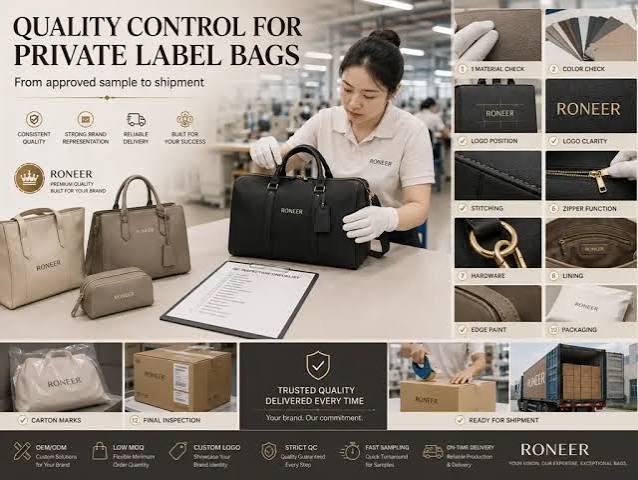
Quality Control Should Begin Before Final Inspection
Quality control is often misunderstood as something that happens only when production is finished.
In reality, quality should be managed throughout manufacturing.
Incoming Material Inspection
Fabrics, lining, webbing, hardware, zippers, and other components should be checked before production begins.
Problems identified at this stage are usually easier to correct.
In-Process Inspection
During manufacturing, teams can monitor stitching, dimensions, reinforcement, assembly, and workmanship.
This helps prevent repeated defects from continuing through the entire production run.
Final Inspection
Finished products should be checked against approved specifications.
Typical inspection points include:
- Fabric color consistency
- Stitch quality
- Seam alignment
- Product dimensions
- Zipper operation
- Hardware finish
- Strap reinforcement
- Logo placement
- Internal cleanliness
- Packaging condition
Clearly defined standards help both the brand and manufacturer understand what is acceptable.
Approved Samples Create a Useful Reference
Once a final sample is approved, it can become an important production reference.
The approved sample helps establish expectations for:
- Materials
- Color
- Dimensions
- Construction
- Hardware
- Logo placement
- Stitching
- Packaging
Written specifications should still be maintained, but a physical approved sample provides an additional reference for production teams.
This is especially useful when a product contains many small details.
Packaging Should Be Planned During Development
Packaging is sometimes treated as an afterthought, but it can affect cost, presentation, shipping efficiency, and customer experience.
Brands may need:
- Poly bags
- Dust bags
- Hang tags
- Branded boxes
- Barcode labels
- Carton markings
- Care labels
- Protective wrapping
Packaging should also be sized appropriately.
Oversized packaging can increase shipping costs, while insufficient protection may lead to damaged products.
For e-commerce brands, packaging may also be part of the customer’s first physical interaction with the brand.
Logistics Can Influence Production Decisions
Manufacturing and shipping should be planned together.
Air freight offers speed but can be expensive for larger volumes.
Sea freight is usually more economical for bulk shipments but requires longer transit times.
Rail or combined transportation may be available for certain destinations.
Brands should consider the shipping method before establishing launch dates.
Production completion does not mean the product is immediately available for sale.
Customs clearance, transportation, warehouse receiving, labeling, and distribution all require additional time.
Scaling Gradually Can Reduce Risk
A successful first product does not necessarily mean a brand should immediately place a very large follow-up order.
Growing brands can benefit from scaling gradually.
Smaller initial production runs provide useful information about:
- Customer demand
- Returns
- Quality feedback
- Preferred colors
- Popular sizes
- Feature preferences
- Price sensitivity
Brands can use this information to improve future production.
Once demand becomes more predictable, order quantities can increase with greater confidence.
Supplier Communication Matters
Clear communication is one of the most important parts of product development.
Brands should provide complete information whenever possible.
This may include:
- Technical drawings
- Dimensions
- Material specifications
- Color references
- Hardware requirements
- Logo files
- Packaging details
- Quantity
- Target price
- Quality standards
- Delivery expectations
Changes should also be documented.
Verbal instructions can easily be forgotten or misunderstood.
Written confirmation helps ensure that both sides are working from the same information.
Successful Private-Label Development Is Collaborative
The strongest development projects usually involve collaboration between the brand and manufacturer.
Brands understand their customers, positioning, and creative direction.
Manufacturers understand materials, construction, production methods, feasibility, and quality control.
When both sides contribute their expertise, development becomes more efficient.
A manufacturer may suggest changing a seam position, reinforcing a handle, adjusting a pocket opening, or using a different material.
These recommendations do not necessarily change the creative concept.
In many cases, they help make the design more durable and easier to manufacture consistently.
Long-Term Product Development Becomes More Efficient
Brands that develop multiple products over time often become faster at the process.
Material libraries become established.
Preferred hardware is identified.
Packaging standards become clearer.
Technical specifications improve.
Quality expectations become more consistent.
Manufacturers also gain a better understanding of the brand’s requirements.
This can reduce repeated explanations and make future development more efficient.
Better Bag Collections Come From Better Development
Successful private-label bag collections are rarely created through one decision.
They result from many connected choices involving the customer, materials, structure, organization, comfort, branding, sampling, manufacturing, quality control, packaging, and logistics.
For growing brands, the most important step is often developing a clear process.
Start with the intended customer.
Define the product position.
Choose materials carefully.
Build and test physical samples.
Evaluate manufacturing feasibility.
Establish quality standards.
Plan production and logistics realistically.
When these areas work together, brands are more likely to create products that look distinctive, perform reliably, and remain consistent as order volumes increase.
Private-label development should therefore be viewed not simply as purchasing finished goods, but as building a repeatable product development system that can support long-term growth.