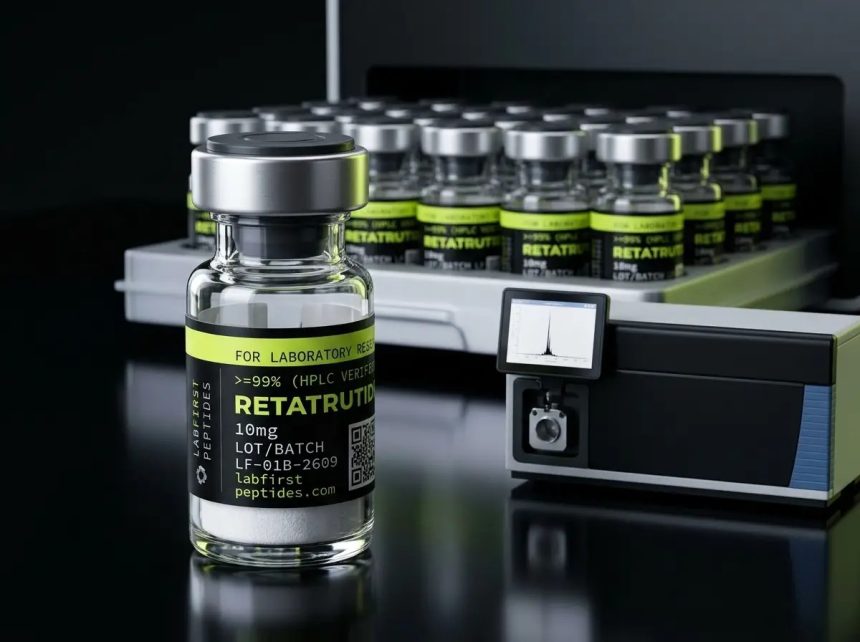
What this guide covers
Retatrutide went from a line in a 2022 scientific paper to one of the most searched research compounds online in about three years. That kind of attention pulls in sellers, and the number of websites listing it has grown faster than anyone’s ability to check what’s actually in the vials.
For a lab, or anyone buying research material, the single most useful habit is also the least glamorous one: reading the certificate of analysis before looking at the price. A certificate is the only document that says what a lab measured in a specific batch. Some say a great deal. Some say very little while looking official. This guide covers what retatrutide is, what a useful certificate contains, the warning signs of a weak one, and how to check a report yourself. Retatrutide is an investigational compound sold for laboratory research use only.
What is retatrutide?
Retatrutide is an investigational peptide developed by Eli Lilly under the research code LY3437943. It is a single molecule designed to act on three hormone receptors (GIP, GLP-1 and glucagon), which is why it’s sometimes nicknamed “GLP-3” online, even though no GLP-3 hormone exists. It is not an approved medicine. What’s sold online is research-grade material meant for laboratory work, and that means there’s no pharmacy or regulator standing between the buyer and the label. The certificate is the check.
What are the three measurements that matter?
A complete certificate answers three different questions. They are easy to blur together, and that blurring is exactly where weak certificates hide.
Identity: is it the right molecule? Identity testing confirms the compound is what the label says. For a peptide like retatrutide, labs typically use liquid chromatography paired with mass spectrometry (LC-MS) to measure the molecule’s mass, then compare it with the mass its structure predicts. The reference value is published in the public PubChem database. A certificate that shows a measured mass close to the reference is giving you evidence. A certificate that only says “conforms,” with no number beside it, is giving you an assertion.
Purity: how much of what’s there is the right thing? Purity is usually measured by high-performance liquid chromatography (HPLC) and reported as a percentage. It’s the number sellers put in their headlines, and it is useful, but it answers a narrower question than most buyers assume. It tells you how uniform the material is. It does not tell you what the material is. A cleanly made batch of the wrong peptide can still post a 99% purity figure, which is why purity without identity proves very little.
Net content: how much is actually in the vial? This is the measurement most often missing, and it may be the one that matters most to anyone comparing prices. A vial labeled “10 mg” contains peptide plus some water and salts left from manufacturing. Net content testing measures how much of the actual peptide is present compared with the label. Without it, there’s no way to know whether a “10 mg” vial holds 10 mg, 8 mg or 12 mg, which makes price-per-milligram comparisons meaningless.
When you look at a retatrutide certificate of analysis, check that all three are there, each with a real value.
What are the red flags?
Weak or recycled certificates tend to fail in predictable ways.
- No lot number, or one that doesn’t match the vial. A certificate has to belong to the specific batch you’re holding. One that isn’t tied to a lot could describe anything.
- Purity only. A single impressive percentage with no identity result is the most common gap.
- The same document everywhere. If the same certificate appears across different products, sizes or months, it’s being reused. Real reports change their dates, sample IDs and lot numbers.
- No way to verify it. A legitimate testing lab lets you confirm a report, by a lookup code or by contacting them with the sample number. If the seller can’t tell you how, treat the document as unverified.
- A lab you can’t find. Search the laboratory’s name. A real testing lab has an address, a phone number and other clients.
How to check a certificate yourself: step by step
The whole point of a certificate is that you shouldn’t have to trust the seller. So don’t.
- Match the lot number on the certificate to the label on the vial.
- Look the report up with the issuing laboratory, using whatever code or sample ID it carries, rather than relying on a copy the seller sends.
- Compare the measured mass with the reference value in PubChem.
- Check that the test date makes sense for the batch you received.
- If anything doesn’t line up, ask the seller to explain it in writing. A straightforward supplier will.
For buyers who want more certainty, independent retesting has become common in the research market. Sending a sealed vial to a separate lab and comparing the results with the seller’s certificate is the strongest check available. A supplier confident in its material shouldn’t object, and some now state in writing what they’ll do if an outside result disagrees. A step-by-step version of this checklist is on our certificates page.
What does good look like?
The more credible research suppliers publish their standard before the sale rather than after a complaint. In practice that means a written release specification, which states the minimum identity, purity and net content a batch must meet before it ships. It also means certificates linked from each product page by lot number, and a clear policy for what happens if an independent test disagrees.
When you’re comparing listings for retatrutide peptide, those details separate a supplier that tests from one that only says it does. Price per milligram matters too, but only after you know the milligrams are really there.
Bottom line
A certificate is only as good as the numbers on it and your ability to confirm them. Look for identity, purity and net content, each with a measured value. Make sure the lot number matches. Verify the report with the lab that issued it. And if a seller makes any of that difficult, treat the difficulty itself as information.
Common questions
What is retatrutide? An investigational peptide developed by Eli Lilly under the research code LY3437943, designed to act on the GIP, GLP-1 and glucagon receptors. It is not an approved medicine, and what’s sold online is research-grade material for laboratory work.
Why isn’t a purity percentage enough? Purity says how uniform the material is, not what it is or how much is in the vial. A batch of the wrong peptide can still post 99%. Identity and net content complete the picture.
How do I verify a certificate? Match the lot number to the vial, look the report up with the issuing lab using its code or sample ID, compare the measured mass with the PubChem reference, and check the test date fits the batch.
Retatrutide is an investigational compound sold for laboratory research use only. It is not approved for human or veterinary use, and nothing in this guide is medical advice.