FIFA World Cup 2026 Teams and the Expanded Tournament Format
The FIFA World Cup 2026 marked a major change in the history of international football, with the tournament expanding from 32 teams to 48 nations. Hosted across the United States, Canada, and Mexico, the competition brought together teams from every FIFA confederation and created a much larger schedule for supporters to follow. For readers checking football information alongside entertainment platforms such as 78win, understanding the new format is especially useful because the 2026 edition introduced more group-stage matches and a new knockout-round structure. Instead of eight groups of four, the tournament featured 12 groups containing four teams each. The top two teams from every group advanced automatically, while the eight best third-placed teams also moved into the knockout phase. That produced a Round of 32 before the familiar Round of 16, quarter-finals, semi-finals, and final.
Key facts about the 2026 team format
- 48 teams competed in the expanded FIFA World Cup.
- The competition featured 12 groups of four teams.
- Each team played three group-stage matches.
- The top two teams in every group qualified for the knockout stage.
- The eight best third-placed teams also advanced.
- The knockout phase began with a Round of 32.
- The tournament was staged across three host countries: Canada, Mexico, and the United States.
- The competition ran from June 11 to July 19, 2026.
FIFA World Cup 2026 Groups and the Nations in Each Group
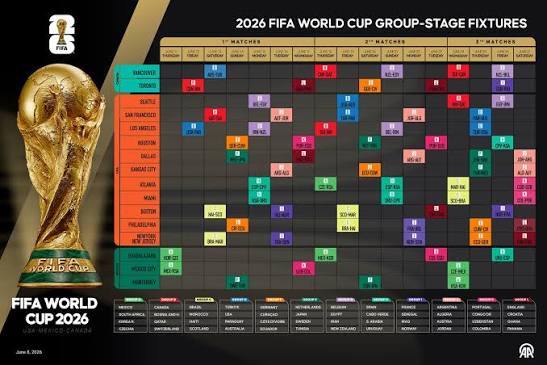
The group stage was one of the most closely followed parts of the tournament because the 48-team format created a wider range of matchups. The draw placed four teams in each of the 12 groups, giving supporters three rounds of group matches before the knockout stage began. Traditional World Cup contenders appeared alongside first-time or less experienced participants, making several groups difficult to predict on paper. Mexico, Canada, and the United States qualified automatically as hosts, while other nations earned their places through continental qualification. The group-stage arrangement also meant that finishing third was no longer automatically the end of a team’s tournament. Instead, third-placed teams were compared across the groups, adding another layer of competition to the final round of group fixtures.
The 12 World Cup 2026 groups
- Group A: Mexico, South Africa, South Korea, and a UEFA play-off qualifier.
- Group B: Canada, Switzerland, Qatar, and a UEFA play-off qualifier.
- Group C: Brazil, Morocco, Haiti, and Scotland.
- Group D: United States, Paraguay, Australia, and a UEFA play-off qualifier.
- Group E: Germany, Curaçao, Ivory Coast, and Ecuador.
- Group F: Netherlands, Japan, Tunisia, and a UEFA play-off qualifier.
- Group G: Belgium, Egypt, Iran, and New Zealand.
- Group H: Spain, Cape Verde, Saudi Arabia, and Uruguay.
- Group I: France, Senegal, Norway, and an intercontinental play-off qualifier.
- Group J: Argentina, Algeria, Austria, and Jordan.
- Group K: Portugal, Colombia, Uzbekistan, and an intercontinental play-off qualifier.
- Group L: England, Croatia, Ghana, and Panama.
FIFA World Cup 2026 Fixtures and How the Match Schedule Worked
The 2026 fixture schedule was considerably larger than previous editions because the tournament included 48 teams and 104 matches. The group stage occupied the opening portion of the competition, with each nation playing three games. This made the final group matches particularly important because teams could qualify, be eliminated, or improve their knockout position depending on results elsewhere. After the group stage, the competition moved into the Round of 32, followed by the Round of 16. From that point, the structure returned to the familiar single-elimination format. Teams needed to win their knockout matches to continue, while draws after regulation time required extra time and, when necessary, penalty shootouts.
Main fixture stages to follow
- Group stage: June 11 through June 27.
- Round of 32: June 28 through July 3.
- Round of 16: July 4 through July 7.
- Quarter-finals: July 9 through July 11.
- Semi-finals: July 14 and July 15.
- Third-place match: July 18.
- World Cup final: July 19.
- A total of 104 matches were scheduled across the tournament.
- Match locations were spread across stadiums in Canada, Mexico, and the United States.
FIFA World Cup 2026 Host Cities and Major Stadiums
One of the defining features of the 2026 World Cup was its geographic scale. Rather than being concentrated in one country, the tournament was distributed across 16 host cities in three nations. Canada hosted matches in Toronto and Vancouver, Mexico staged games in Mexico City, Guadalajara, and Monterrey, while the United States hosted the largest share of fixtures across several major metropolitan areas. This setup gave the tournament a distinctly North American character and required teams and supporters to account for long travel distances, different climates, and changing time zones. The opening match took place in Mexico City, while the championship match was scheduled for the New York/New Jersey area.
The 16 host cities
- Canada: Toronto and Vancouver.
- Mexico: Mexico City, Guadalajara, and Monterrey.
- United States: Atlanta, Boston, Dallas, Houston, Kansas City, Los Angeles, Miami, New York/New Jersey, Philadelphia, San Francisco Bay Area, and Seattle.
- The opening match was held at Estadio Azteca in Mexico City.
- The final was held at MetLife Stadium in East Rutherford, New Jersey, in the New York metropolitan area.
- The three host countries provided a mix of large cities, different climates, and extensive transport networks.
- Supporters traveling between venues needed to consider significant distances between some match locations.
FIFA World Cup 2026 Key Tournament Dates Every Fan Needed to Know
The tournament calendar provided several important milestones for supporters, teams, broadcasters, and event organizers. June 11 was the starting point, with the opening fixture in Mexico City beginning a competition that lasted more than five weeks. The group stage then determined which nations would enter the expanded knockout phase. Because 32 teams qualified for the first knockout round, the tournament maintained a busy schedule before reaching the final 16. The quarter-finals reduced the field to eight teams, followed by the semi-finals, third-place match, and championship game. The final on July 19 represented the climax of the 2026 competition and completed a tournament featuring 104 matches.
The dates worth remembering
- June 11, 2026: FIFA World Cup opening day.
- June 11-27: Group-stage fixtures.
- June 28-July 3: Round of 32.
- July 4-7: Round of 16.
- July 9-11: Quarter-finals.
- July 14-15: Semi-finals.
- July 18: Third-place play-off.
- July 19: FIFA World Cup final.
- The complete competition lasted 39 days from opening match to final.
Biggest Teams, Players, and Storylines to Watch
The expanded World Cup created opportunities for established football powers and ambitious emerging teams alike. Argentina entered the tournament as the reigning world champion from 2022, while Brazil, France, Germany, Spain, England, Portugal, and the Netherlands were among the nations expected to attract considerable attention. Morocco also carried significant interest after becoming the first African nation to reach a World Cup semi-final in 2022. The host nations brought another major storyline, especially because the United States, Canada, and Mexico were able to play in front of home supporters. Individual stars also remained central to the tournament’s appeal. Established names, younger talents, and players competing at the highest club level all had the chance to shape their nations’ campaigns. Fans using football-focused services or searching for related entertainment content, including 78win đá gà, could still find the World Cup particularly compelling because of the wide variety of teams and matchups.
Major storylines around the tournament
- Argentina entered as the defending world champion.
- Brazil remained one of the most successful and recognizable teams in World Cup history.
- France continued to be a major contender after reaching consecutive finals in 2018 and 2022.
- Germany, Spain, England, Portugal, and the Netherlands brought strong tournament traditions and high expectations.
- Morocco represented one of the most significant recent success stories from African football.
- The United States, Mexico, and Canada had the advantage of playing on home soil.
- The expanded format gave emerging football nations more opportunities to compete on the world’s biggest stage.
How the 2026 World Cup Format Changed the Road to the Final
The most important structural change was the introduction of the Round of 32. In the traditional 32-team format, 16 nations moved directly from the group stage into the Round of 16. With 48 teams in 2026, 32 nations qualified for the first knockout round. This meant that the tournament included more matches and created additional opportunities for teams to make a deep run. At the same time, the group stage became more complicated because third-placed teams could still qualify. Goal difference, goals scored, disciplinary records, and other applicable ranking criteria could become important when teams finished level on points. For supporters, this meant that a team could remain alive until the final group matches even after failing to finish in the top two. The larger format also increased the number of potential knockout matchups between traditional powers and less experienced World Cup teams.
What supporters needed to understand
- First and second place in every group qualified automatically.
- The eight strongest third-placed teams also advanced.
- A total of 32 teams entered the knockout stage.
- The first knockout round was the Round of 32, rather than the Round of 16.
- Every knockout match required a winner.
- Drawn knockout matches could go to extra time and penalties.
- The expanded format increased the total tournament schedule to 104 matches.
- Group-stage results remained crucial because ranking position could affect the knockout path.
Conclusion: FIFA World Cup 2026 Teams, Groups, Fixtures, and Key Tournament Dates Made the Expanded Competition a Historic Global Football Event
The FIFA World Cup 2026 represented one of the biggest changes to the competition’s modern format, bringing 48 national teams together across Canada, Mexico, and the United States. With 12 groups, 104 matches, and a Round of 32, supporters had more football to follow than in any previous edition. The tournament began on June 11 in Mexico City and concluded with the final on July 19 in the New York/New Jersey area. The group-stage system also created new possibilities because third-placed teams could qualify, meaning the final group fixtures carried additional importance. Alongside traditional powers such as Argentina, Brazil, France, Germany, Spain, England, and Portugal, the expanded field gave more nations the opportunity to compete on football’s biggest stage. The geographic spread of the event added another distinctive feature, with matches taking place in 16 cities and three countries. For anyone looking back at the 2026 competition, understanding the teams, groups, fixture stages, host cities, and key dates provides a clear picture of how the tournament was structured. More importantly, the expanded format showed how international football continues to evolve, creating a World Cup that was larger in scale, broader in participation, and packed with more matches from the opening whistle through the championship game.
Final World Cup 2026 reference points
- Teams: 48 national teams.
- Groups: 12 groups of four.
- Total matches: 104.
- Host countries: Canada, Mexico, and the United States.
- Host cities: 16.
- Opening date: June 11, 2026.
- Final date: July 19, 2026.
- Knockout format: Round of 32, Round of 16, quarter-finals, semi-finals, third-place match, and final.
- Qualification from groups: The top two teams plus the eight best third-placed teams.
- Overall significance: The 2026 edition established the expanded 48-team World Cup format and created a substantially larger international football event.