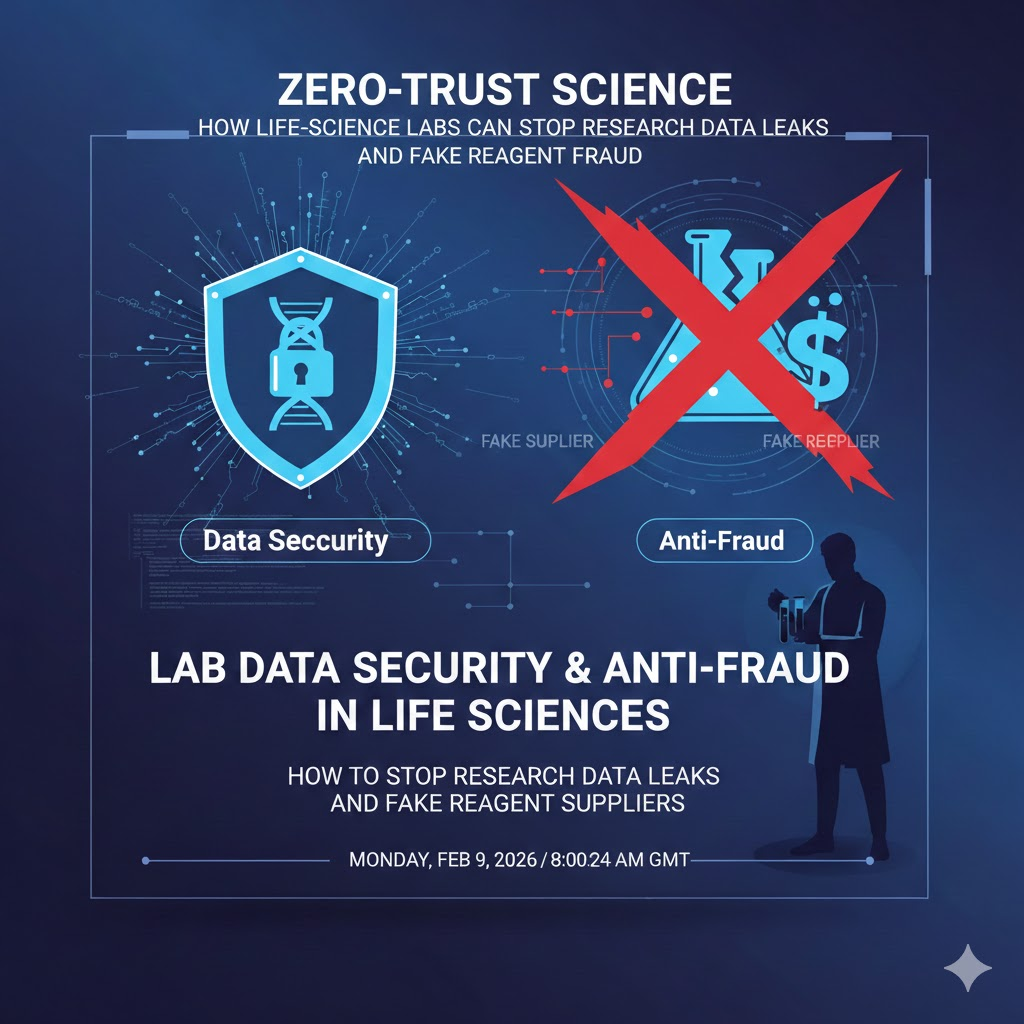
Life-science labs are becoming high-value targets for two reasons: the data is monetizable (IP, patient-linked datasets, proprietary methods), and the workflows are time-sensitive (a single compromised batch can invalidate weeks of work). While many teams focus on cyber hygiene in the abstract, real-world incidents typically start in the mundane: a shared instrument PC with weak access controls, a “too-good-to-be-true” antibody supplier, a compromised courier label, or a third-party contractor account that never got offboarded.
This article lays out a pragmatic, technical playbook for preventing research data leakage and intercepting fraudulent bio-reagent suppliers—without slowing down discovery. Where relevant, we’ll also note how “non-obvious” operational controls (including compliant packaging choices from partners like Bioleader) can reduce tampering risk in sample logistics and inbound materials handling. As procurement teams harden supplier gates, simple physical controls—sealed staging, standardized receiving, and tamper-evident handling—often become the difference between “we noticed” and “we assumed.”
The Threat Model Most Labs Get Wrong
Many labs assume threats are either “external hackers” or “internal bad actors.” In practice, the highest-frequency failures sit in the middle: hybrid threat chains that combine social engineering, supply-chain fraud, and weak segmentation.
Common attacker objectives in life sciences
- IP theft: protocols, formulations, assay conditions, proprietary sequences.
- Pre-publication sabotage: dataset poisoning, selective deletion, or subtle parameter drift.
- Credential harvesting: instrument PCs, shared lab accounts, vendor portals, eProcurement logins.
- Supply-chain insertion: counterfeit reagents, relabeled expired kits, adulterated buffers, or cold-chain breaks.
Why life-science environments are uniquely exposed
- Instrument islands: legacy OS versions, vendor-locked systems, always-on controllers.
- Data sprawl: ELNs, LIMS, local spreadsheets, cloud drives, ad-hoc external sharing.
- Time pressure: labs accept risk when a study timeline is threatened, which fraudsters exploit.
A mature approach starts with one principle: assume compromise is possible at every handoff—human, digital, and physical—and build layered verification.
Preventing Research Data Leakage with a Lab-Realistic Zero-Trust Architecture
“Zero trust” does not mean “block everything.” It means continuously verify identity, device health, and authorization at each access request—especially around scientific data pipelines.
Segment the Lab Like a Factory, Not an Office
A typical lab network has four zones that should never be flat:
- Instruments & controllers: sequencers, LC-MS, imaging, incubators, robotics.
- Data services: LIMS/ELN, file servers, object storage, analytics clusters.
- User endpoints: analyst laptops, shared lab PCs.
- Third parties: vendor remote support, service engineers, integrators.
Technical baseline
- Put instruments behind dedicated VLANs with strict east-west rules.
- Use jump hosts for any admin access; ban direct RDP/SMB from general networks.
- Enforce egress allowlists for instrument VLANs (many compromises exfiltrate via DNS/HTTPS).
- Log cross-zone flows; treat unusual traffic as an incident until explained.
Lock Down the “Shared Instrument PC” Problem
Shared PCs are a common failure point. They accumulate credentials, run outdated drivers, and become the bridge to everything else.
Controls that work in labs
- Per-user authentication even on shared stations (badge + MFA or passkeys).
- No local admin for routine users; vendor tools run under managed elevation.
- Application allowlisting for instrument stations; block random executables and scripting shells.
- USB policy: allow only signed, encrypted lab-approved media; log all mounts.
Make Data Integrity Verifiable, Not Assumed
Data leaks are bad; data integrity loss can be worse because it invalidates research without obvious signals.
Implement tamper-evident data handling
- Use write-once / object-lock storage for raw instrument outputs and primary datasets.
- Generate hash manifests automatically at acquisition and at each transfer step.
- Maintain chain-of-custody logs in the LIMS/ELN: who accessed, who transformed, what pipeline version, what parameters.
Fake Reagent Suppliers: The Fastest Way to Corrupt “Valid-Looking” Results
Counterfeit or fraudulent reagents don’t always fail loudly. The most dangerous cases are near matches that produce plausible but biased outcomes. A robust receiving-and-quarantine workflow (photo capture, seal checks, temperature indicator review, and two-person receiving for critical lots) is a low-cost control that prevents “quiet swaps.” Some labs also standardize secondary containment and staging with rigid, PFAS-free molded-fiber packaging—such as PFAS-free bagasse clamshell boxes for secure receiving, staging, and kit organization—to keep lot labels visible, prevent cross-mixing, and preserve traceability before materials are released to benches.
Recognize the Operational Red Flags
- Unusual discounts on scarce items (antibodies, enzymes, qPCR kits).
- Vague COAs or templated COAs that repeat across lots.
- Lot numbers that don’t reconcile with manufacturer formats.
- Cold-chain products shipped without credible temperature-control evidence.
- Pressure tactics: “pay today,” “only a few left,” “customs will destroy it.”
Build a Supplier Verification Gate That Is Fast but Strict
Minimum verification package
- Traceable COA: lot-specific, with method references and acceptance criteria.
- Lot verification: confirm lot structure and manufacturing origin patterns; escalate anomalies.
- Stability & storage documentation: excursion tolerances and validated shelf-life claims.
- Business legitimacy checks: consistent address, tax registration, domain history, and bank details matching corporate identity.
Operational tip: treat any change to bank account details as high-risk and verify through a second channel.
Use “Sentinel Testing” for High-Impact Reagents
- Antibodies: known-positive/known-negative controls benchmarked to history.
- Enzymes: activity testing against reference substrates and curve comparison.
- Cell culture reagents: mycoplasma risk screening, endotoxin claim checks, reference cell-line performance.
A Unified Playbook: Stop Leaks and Fraud with the Same Control Framework
Data security and reagent authenticity are often handled by different teams. That’s a mistake. Both problems reduce to four control pillars:
Pillar 1: Identity and Authorization
- Unique identities for people and service accounts.
- MFA for privileged actions and external access.
- Time-bounded access for vendors and contractors.
Pillar 2: Integrity and Traceability
- Hashing and immutable storage for raw data.
- Chain-of-custody logs for samples and datasets.
- Lot tracking tied to experiments in the LIMS.
Pillar 3: Segmentation and Containment
- Network segmentation for instruments and data services.
- Physical quarantine zones for incoming materials.
- Controlled internal logistics with consistent staging and labeling.
Pillar 4: Detection and Response
- Monitor for anomalous access patterns and data egress.
- Alert on unusual vendor behaviors (bank changes, shipping deviations).
- Predefined incident procedures for suspected counterfeit lots or dataset tampering.
Metrics That Prove You’re Actually Safer
- Mean time to detect suspicious access or data transfers.
- Percent of critical instruments segmented with restricted egress.
- Coverage of immutable storage for raw outputs (by instrument type).
- Supplier verification compliance rate for high-impact reagents.
- Incoming QC pass/fail rates by supplier and reagent class.
- Incident drill performance: quarantine speed and blast-radius tracing.
Conclusion: The Competitive Advantage of Trustworthy Science
Life-science organizations win on speed, but they keep winning on trustworthy results. Data leakage erodes competitive advantage; counterfeit reagents erode scientific validity. The most resilient labs treat both as one end-to-end assurance problem—digital, operational, and physical.
The next step is straightforward: map your highest-value data and highest-impact reagents, then implement segmentation, traceability, supplier gates, and sentinel testing where risk is concentrated. Do that, and you’ll reduce the probability of catastrophic loss while preserving the throughput your research teams need.